Time to modernize the Copyright Office for the digital age

This article originally appeared in The Hill on October 29, 2015 There is not much disagreement that the Copyright Office, which administers the U.S. copyright system and serves the over $1.1 trillion market for copyrighted works, needs to modernize. Even the federal government agrees. In March, the Government Accountability Office (GAO) released two reports concluding that the Library of Congress has been woefully mismanaged, and the Copyright Office, which resides in the Library, needs better IT systems. Taxpayers, and all citizens, should expect that government utilize technology and common sense when modernizing all operations. But like all debates in Washington, the devil is in the details. For instance, as a capstone to Chairman Bob Goodlatte’s (R-Va.) two-year copyright review process, Reps. Tom Marino (R-Pa.) and Judy Chu (D-Calif.) circulated a discussion draft of the CODE Act suggesting that the Copyright Office become an independent agency. They reason that the office will have the best chance to modernize if granted increased independence, which would allow the office to focus on self-improvement as opposed to competing with other functions of the Library. Many free market organizations welcomed the draft as a good starting point for discussion. The Internet Association and anti-copyright coalition Re:Create did not.

Continue ReadingTime to modernize the Copyright Office for the digital age

Deadly Doses: Recreational Drug Experiments on Animals and How It Wastes Millions of Tax Dollars, November 2015

Animal Justice Project USA and the Taxpayers Protection Alliance have united to uncover an epidemic of deplorable government spending on recreational drug experiments on animals as part of the Animal…

Continue ReadingDeadly Doses: Recreational Drug Experiments on Animals and How It Wastes Millions of Tax Dollars, November 2015

TPA Releases New Joint Report on Costly and Questionable Animal Testing Studies

Washington, D.C. - Today, the Taxpayers Protection Alliance (TPA) released a report in cooperation with the Animal Justice Project detailing the disturbing facts about drug experimentation on animals and what the practice is costing taxpayers. The report, Deadly Doses: Recreational Drug Experiments on Animals & How it Wastes Millions of Tax Dollars, examines animal drug testing programs that are being bankrolled by the American taxpayer. Studies that involve LSD, cocaine, ecstasy, other recreational drugs and what amounts to animal torture are being funded by the American taxpayer to uncover the secrets of the blink-rate of rabbits, the decision-making skills of monkeys, and other nonsensical research priorities. TPA President David Williams blasted the wasteful spending revealed in the report, and called out the Department of Health and Human Services (HHS) and the National Institutes of Health (NIH) for the outrageous waste of taxpayer money on these studies.

Continue ReadingTPA Releases New Joint Report on Costly and Questionable Animal Testing Studies

TPA Joins Coalition Urging Congress to Defund Department of Labor Fiduciary Rule

The Obama Administration has been consistent in there increased use of the executive branch of government to undermine Congress, many times to the point where the courts have rebuked them for violating the law. Federal agencies have played a large role in this, with new regulations coming from cabinet departments on a daily basis costing taxpayers and the economy. One recent example of this alarming practice is a new “fiduciary rule” out of the Department of Labor (DOL), which would effectively give the agency the authority to, “greatly restrict investment choices for 401(k)s, individual retirement accounts (IRAs) and other saving vehicles.” DOL has never had this authority and Congress has not granted it to them, yet here comes the Obama Administration making up new rules as they go along. The new rule would restrict the choices Americans have to choose who will handle their investments, and would make it harder for many families to even work with investment professionals. TPA is adamantly opposed to the rule recognizing the damage it would do to the financial services industry, and just a few weeks ago signed this letter from the Competitive Enterprise Institute along with more than 30 other groups. The coalition urges the House and Senate to defund any part of the DOL budget that would enforce this rule. Click 'read more' below for more information

Continue ReadingTPA Joins Coalition Urging Congress to Defund Department of Labor Fiduciary Rule

GOP Debate Number Three: The Economic Debate That Wasn't

The 2016 campaign continues to be a major part of the discussion as candidates from both parties travel across the country attempting to woo voters. The debates are supposed to be a platform where the candidates can separate themselves and provide clarity about what plans they have on specific policy areas. Unfortunately, the debates have not provided a real discussion on issues. Instead, they have become a melee of zingers and one-liners. Last week’s third GOP primary debate was one of the least substantive and what makes matters worse is that weeks of buildup centered around the promise that it would be focused on economic issues, an important topic of discussion as the economy struggles and the country is faced with a $18 trillion debt. In Boulder, Colorado last Wednesday ten of the remaining fifteen GOP candidates met on stage to debate what CNBC billed as a debate centered on economic issues. The Taxpayers Protection Alliance (TPA) was looking forward to hearing the moderators ask questions about tax reform, regulatory policy, entitlement reform, and pro-growth ideas. Frank exchanges about the candidates views and plans on these issues would have been a win for the candidates, CNBC, and taxpayers. But, instead, the audience of 14 million was treated to a bizarre debate where the moderators, as much as the candidates, failed to provide voters with any substance. Considering that a two-year budget deal that busted the budget caps was passed by the House and Senate last week, a golden opportunity to talk about fiscal issues was lost.

Continue ReadingGOP Debate Number Three: The Economic Debate That Wasn't
Read more about the article TPA Presents the 2015 Taxpayer Tricks and Treats!
Jack-o'-lanterns carved from pumpkins and lit with tea lights

TPA Presents the 2015 Taxpayer Tricks and Treats!

Halloween this weekend so that means families all over the country are getting ready to celebrate with candy and costumes. The Taxpayers Protection Alliance (TPA) however, is getting ready for the scary season by keeping our eye on what government has been doing to taxpayers over the past year. That’s right, it’s time for TPA’s annual Taxpayer Tricks and Treats! This year, there’s plenty for taxpayers to be frightened of with threats of government shutdowns, uncertainty with spending bills, and a host of other ghoulish scares that Washington is bringing to working families this year.

Continue ReadingTPA Presents the 2015 Taxpayer Tricks and Treats!
Read more about the article Why This Budget Deal Makes No Sense For Taxpayers
President Barack Obama shakes hands with Speaker of the House John Boehner before delivering the State of the Union address at the U.S. Capitol in Washington, D.C., Jan. 25, 2011. (Official White House Photo by Pete Souza) This official White House photograph is being made available only for publication by news organizations and/or for personal use printing by the subject(s) of the photograph. The photograph may not be manipulated in any way and may not be used in commercial or political materials, advertisements, emails, products, promotions that in any way suggests approval or endorsement of the President, the First Family, or the White House. 

Why This Budget Deal Makes No Sense For Taxpayers

This article originally apeared in The Daily Caller on October 27, 2015 It was announced on Monday night that congressional leaders and the White House have agreed to a two-year budget deal that lifts the budget caps by $80 billion. In addition to lifting the budget caps, the debt ceiling will be suspended until 2017. That’s not a compromise, that’s capitulation. The budget caps were put in place in 2011 because the country was faced with a debt-ceiling crisis. Sound familiar? The Budget Control Act (BCA) of 2011, which set the caps and ultimately led to sequestration, was Congress and the president admitting they couldn’t be trusted to be fiscally responsible. The spending caps set forth by the BCA and implemented through sequestration are the first nominal (real) cuts in spending that the federal government has seen in decades. The latest budget deal busts the caps by $80 billion; $50 billion in fiscal year (FY) 2016 and $30 billion in FY 2017. The increase would be equally divided between defense and non-defense discretionary spending, neither of which need more money.

Continue ReadingWhy This Budget Deal Makes No Sense For Taxpayers

Discharge Petition Provides Chance for House to Resurrect Crony Ex-Im Bank

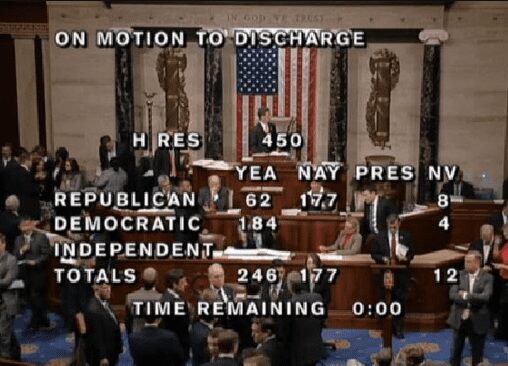
Last night the House of Representatives moved to bring back the Export-Import Bank, a glaring symbol of crony capitalism. The method by which members of Congress did this was a little known parliamentary tool called a discharge petition. A discharge petition is generally used by members of the minority party in order to get legislation onto the floor by subverting the normal committee process. In fact, the last time it was used was back in 2002. In this case, it was Rep. Stephen Fincher (R-Tenn.) who worked with House Minority Leader Nancy Pelosi (D-Calif.) and Rep. Maxine Waters (D-Calif.) to secure the 218 needed signatures to file the petition to the floor. In the end, 62 GOP members voted (246-177) to bring back the crony bank. Today there will be a vote on Rep. Fincher’s bill, H.R. 597, Reform Exports and Expand the American Economy Act, to reauthorize Ex-Im, Yesterday, the Taxpayers Protection Alliance (TPA) sent a letter to all members of the House urging them to vote against the Fincher bill and keep the Ex-Im Bank from coming back to “haunt” taxpayers. It is unclear what will happen after today’s vote, and nobody knows for sure what Senate Majority Leader Mitch McConnell (R-Ky.) will do, but TPA will be watching today’s vote and paying careful attention to what happens in the Senate. Click 'read more' below to see the full letter

Continue ReadingDischarge Petition Provides Chance for House to Resurrect Crony Ex-Im Bank
Read more about the article TPA Presents the 2015 Taxpayer Tricks and Treats!
Jack-o'-lanterns carved from pumpkins and lit with tea lights

TPA Presents the 2015 Taxpayer Tricks and Treats!

Halloween is just around the corner so that means families all over the country are getting ready to celebrate with candy and costumes. The Taxpayers Protection Alliance (TPA) however, is getting ready for the scary season by keeping our eye on what government has been doing to taxpayers over the past year. That’s right, it’s time for TPA’s annual Taxpayer Tricks and Treats! This year, there’s plenty for taxpayers to be frightened of with threats of government shutdowns, uncertainty with spending bills, and a host of other ghoulish scares that Washington is bringing to working families this year.

Continue ReadingTPA Presents the 2015 Taxpayer Tricks and Treats!

Big Solar's Dark Side

This article originally appeared in the Morning Consult on September 30, 2015 There are political charades by hired guns, billions of dollars in loan guarantees and taxpayer subsidies, and advocacy groups funded by Silicon Valley’s mega rich engaging in guerilla-like campaign tactics. This might appear to be a movie or an episode of House of Cards, but this is reality and it’s all in a day’s work for the new Wall Street get-rich scam of rooftop solar leases. At the center of all of this deceit and fleecing of taxpayer dollars is innovative entrepreneur turned subsidy king, Elon Musk. At the heart of big solar’s worries and Musk’s shenanigans is the policy of net metering, which requires utility companies to purchase electricity from solar power companies. Enacted years ago to spur the growth of distributed generation like rooftop solar, net metering reimburses homeowners with solar panels for the energy they produce. Net metering has become nothing more than a subsidy given to give solar companies as an unfair competitive advantage.

Continue ReadingBig Solar's Dark Side