Taxpayer Watchdog Slams White House Proposal to Raise Taxes

Washington, D.C. – The Taxpayers Protection Alliance (TPA) slammed a tax hike proposal laid out by the White House over the weekend. The proposal represents the first significant tax increase on Americans in roughly three decades and comes at a time when the nation can least afford it.

Continue ReadingTaxpayer Watchdog Slams White House Proposal to Raise Taxes

TPA Releases 2021 Issue Briefs: Roadmap to Fiscal Sanity for the 117th Congress

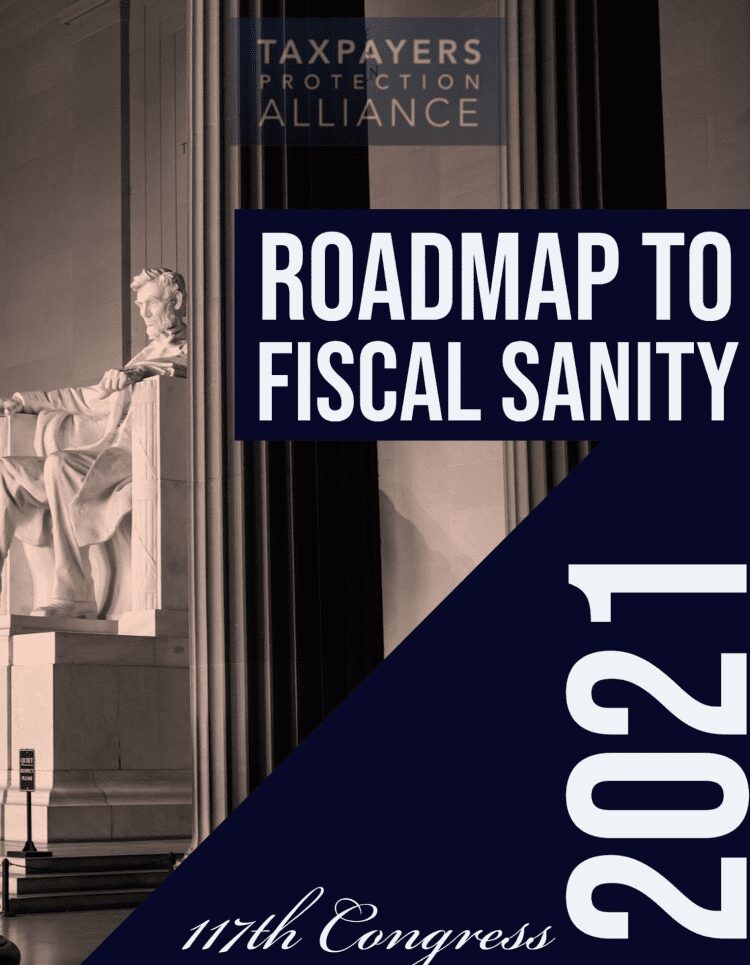
Today, the Taxpayers Protection Alliance (TPA) released a series of issue briefs for the 117th Congress titled Roadmap to Fiscal Sanity. The publication provides detailed policy background on seventeen issue areas and outlines policy recommendations for lawmakers to use as a reference for the country to recover from the pandemic in a fiscally responsible manner.

Continue ReadingTPA Releases 2021 Issue Briefs: Roadmap to Fiscal Sanity for the 117th Congress

TPA Releases 2021 Issue Briefs: Roadmap to Fiscal Sanity for the 117th Congress

Today, the Taxpayers Protection Alliance (TPA) released a series of issue briefs for the 117th Congress titled Roadmap to Fiscal Sanity. The publication provides detailed policy background on seventeen issue areas and outlines policy recommendations for lawmakers to use as a reference for the country to recover from the pandemic in a fiscally responsible manner.

Continue ReadingTPA Releases 2021 Issue Briefs: Roadmap to Fiscal Sanity for the 117th Congress

New Study Shows Folly of Net Neutrality Regulations Around the Globe

With President Joe Biden in office and Jessica Rosenworcel being named as acting head of the Federal Communications Commission (FCC), there is likely to be a renewed push for the reimplementation of Title II regulations on internet providers. A new study indicates that net neutrality rules have harmed the growth of fiber infrastructure and high-speed internet adoption around the world.

Continue ReadingNew Study Shows Folly of Net Neutrality Regulations Around the Globe

Protected: TPA Releases 2021 Issue Briefs: Roadmap to Fiscal Sanity for the 117th Congress

Today, the Taxpayers Protection Alliance (TPA) released a series of issue briefs for the 117th Congress titled Roadmap to Fiscal Sanity. The publication provides detailed policy background on seventeen issue areas and outlines policy recommendations for lawmakers to use as reference for our country to recover from the pandemic in a fiscally responsible manner.

Continue ReadingProtected: TPA Releases 2021 Issue Briefs: Roadmap to Fiscal Sanity for the 117th Congress

Coalition Urges Congress to Reject Financial Transactions Tax

On behalf of millions of taxpayers and investors across the country, we urge you to reject any proposal to implement a financial transactions tax (FTT) on American savers and investors. The Left has seized on the recent GameStop trading controversy to call for a “small” FTT that could purportedly increase federal revenues by $1 trillion over the next decade. This would impose a 0.1 percent tax rate on all buying and selling of stocks, bonds, and other financial instruments.

Continue ReadingCoalition Urges Congress to Reject Financial Transactions Tax

Op-Ed: COVID ‘relief’ Brimming with Wasteful Spending

Just prior to World War I, the United States were virtually debt free and often operated under a budget surplus. Then, along came Woodrow Wilson. Wilson’s deficits added roughly $22 billion to the national debt, an almost eight-fold increase from the debt with which he began his term. After a brief spell of restraint by Presidents Warren G. Harding and Calvin Coolidge – paring back the debt by roughly $6 billion over eight years – America’s lawmakers have thrown caution to the wind when it comes to spending, debts and deficits.

Continue ReadingOp-Ed: COVID ‘relief’ Brimming with Wasteful Spending

The WHO’s Support of Ukraine’s Tax on Heated Tobacco Products Unfairly Burdens Tobacco Harm Reduction, Increases Smuggling

The taxpayer-funded World Health Organization (WHO) has been under criticism for more than a year after failing to alert the world about the COVID-19 pandemic. The WHO is also blocking new innovative products that help people kick the deadly habit of traditional cigarettes. Now, in Ukraine, thanks to WHO intervention, tobacco harm reduction products are about to get more expensive. In January, the Verkhovna Rada (Ukraine’s parliament) adopted amendments to the Tax Code of Ukraine which raises the tax on heated tobacco products (HTPs) “by 4-fold, from 1139.76 Ukrainian hryvnia (UAH) per kilogram to 1456.3 UAH per 1000 sticks.” When all is said and done, HTPs will cost just as much as combustible cigarettes.

Continue ReadingThe WHO’s Support of Ukraine’s Tax on Heated Tobacco Products Unfairly Burdens Tobacco Harm Reduction, Increases Smuggling

Price Controls Are A Bitter Pill To Swallow

In the country’s long, grim struggle with the coronavirus pandemic, lawmakers on both sides of the aisle are trying to give struggling Americans a hand up. And with a 50-50 split in the Senate, excessively partisan measures – such as a $15 minimum wage – are fortunately being cast aside as non-starters. However, harmful measures such as price controls on lifesaving medications threaten to stymie health care innovation and make treating pandemic patients all the more difficult. Lawmakers must ensure that COVID-19 relief efforts are stripped of poison pills such as drug price controls, and work with Food and Drug Administration officials to mend a deeply dysfunctional medication approval process. Millions of lives depend on sensible governance.

Continue ReadingPrice Controls Are A Bitter Pill To Swallow

Comment to Health Canada Regarding A Proposed Limit on Nicotine Strengths in Vapor Products

Reducing nicotine levels may also have unintended consequences. For example, a 2016 study in Drug and Alcohol Dependence examined long-term, daily e-cigarette users. The study found that participants, over time, “decreased the concentration of nicotine in their liquids, but increased their consumption of e-liquid in order to maintain their cotinine levels constant.” Cotinine is product that is formed after nicotine enters the body. A 2020 study in Tobacco Control examined the possibility of “regulations that limit liquid nicotine concentration may drive users to adopt the higher wattage devices to obtain a desired nicotine yield.”[8] The authors found that “reducing the liquid nicotine concentration resulted in greater among of liquid aerosolized and greater [carbonyl compound] emissions.” The study concluded that “regulatory limits on nicotine concentration may have the unintended consequences of increasing exposure to aerosol and respiratory toxicants.”

Continue ReadingComment to Health Canada Regarding A Proposed Limit on Nicotine Strengths in Vapor Products