TPA Sends Letter to Tennessee State Legislature Regarding New or Expanded Government Broadband Initiatives

Chattanooga, TN (courtesy, Wikimedia) If there is one thing that government really enjoys and that is moving in on the private sector. There are always major problems, regardless of the project or the motives behind any such move by the public sector when it comes to encroaching on the private sector. One example is the continued attempts at government broadband expansion and TPA has written before about such initiatives in Louisiana and Tennessee; and how taxpayers aren’t getting the bang for their buck when it comes to these programs. Now, there is talk in Tennessee that some form (or forms) of legislation may be forthcoming and TPA President David Williams decided to send a letter all members of the State legislature regarding any creation or expansion of government broadband projects. Click 'read more' below to read the full letter


Continue ReadingTPA Sends Letter to Tennessee State Legislature Regarding New or Expanded Government Broadband Initiatives

Congress Watch: Taxpayers Underwater with National Flood Insurance Program

(Joe Jansen has a decade and a half of experience working as a staff member on Capitol Hill. He has worked in almost every legislative capacity in both the House and Senate. Joe will be a frequent contributor to TPA’s blog.) The National Flood Insurance Program (NFIP) owes the treasury more than $24 billion. In 2012, when NFIP’s debt was “only” $17 billion, Congress enacted a set of reforms to make the program more actuarially sound. The implementation of these reforms has begun and homeowners and local communities located in flood zones are beginning to feel their impacts. The Senate has already bowed to the pressure and killed the reforms. Taxpayers should demand better. Prior to 1968, when a flood occurred in the United States, the Federal government provided disaster relief funding to the flooded areas. In an attempt to rein in spending, Congress enacted the National Flood Insurance Program. Under the program, the Federal Emergency Management Agency (FEMA) produces flood maps. If your home is in a flood zone, you are required to obtain flood insurance in order to get a mortgage. Unfortunately, the premiums paid by homeowners are not necessarily linked to risk. As an inducement to enter the program, some homeowners were given subsidized rates – rates that were “grandfathered” to prevent increases from reflecting actual flood risks. In years without significant flooding, the premiums might cover the actual costs of the claims. But, in years with significant events such as Hurricanes Katrina and Sandy, the program is forced to borrow funds from the treasury to pay claims. The program now owes more than $24 billion – an amount it is unlikely to ever be able to repay.

Continue ReadingCongress Watch: Taxpayers Underwater with National Flood Insurance Program

Tax Reform Takes Step in Right Direction But More Work Needs to be Done

It’s not often that tax reform takes center stage in Washington, D.C, but when House Ways and Means Committee Chairman Camp released his draft legislation on Wednesday, Washington, D.C., and the country, was abuzz.There was so much anticipation that folks started critiquing the plan before it was even released. Besides simplifying the tax code with an enhanced standard deduction, there are a handful of positive elements, including: the plan replaces seven brackets of income tax with three and reduces the to rate from 39 percent to 35 percent; there would be an increase in the standard deduction from $12,200 to $22,000 for married couples filing jointly. This would allow more than 90 percent of taxpayers to receive the largest reduction with the need of itemizing; the plan would lower the corporate tax rate fro 35 percent to 25 percent. This would be a huge accomplishment for businesses and the country as a whole (read previous TPA blog postings on the corporate tax here, here, and here); and Camp’s tax plan would also eliminate the tax exemptions for professional sports leagues like the National Football League (NFL) and the National Hockey League (NHL).There are some problems with the bill. The most glaring problem is the surtax on families making $450,000 or more. There is also an asset tax of 0.035 percent of financial assets for banks with assets of more than $500 billion.

Continue ReadingTax Reform Takes Step in Right Direction But More Work Needs to be Done

LEED Standards Continue to be Discriminatory to Forestry Industry

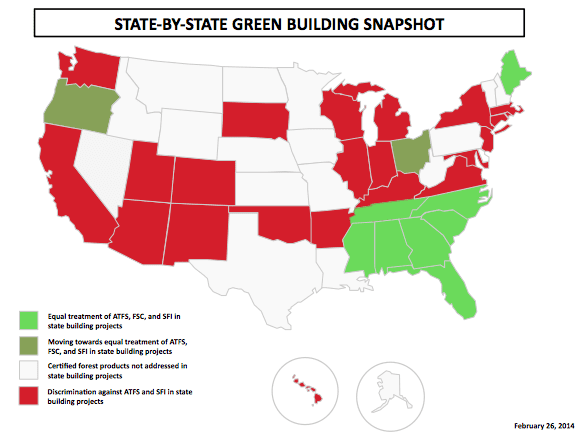
Infographic above shows how LEED standards discriminate against Forestry The Taxpayers Protection Alliance has highlighted how the U.S. Green Building Council’s Leadership in Energy and Environmental Design (LEED) green building certification system increases construction costs without guaranteeing greater energy efficiency. TPA has also explained how policies enforcing LEED standards unfairly discriminate against timber harvested from millions of acres of responsibly managed American forestland. Specifically, LEED standards award a credit for certified wood to encourage sound management of forests. LEED, however, only recognizes timber certified by the Forest Stewardship Council (FSC), an international organization with standards that vary greatly. As a general matter, its standards are more stringent in the U.S., while significantly less stringent abroad – where 90 percent of FSC’s certified land can be found. Competing programs such as the Sustainable Forestry Initiative (SFI) and the American Tree Farm System (ATFS) enforce uniform standards, but they are not recognized by LEED, and timber harvested from forests certified by SFI and ATFS can get blocked from LEED projects. It doesn’t make sense how an organization or government agency can defend a framework that considers wood harvested in (and transported from) Russia and Brazil under lax standards more “green” than wood harvested in the U.S. under stricter standards. Taxpayers shouldn’t be subsidizing public building and renovation projects that use foreign timber while discriminating against American wood.

Continue ReadingLEED Standards Continue to be Discriminatory to Forestry Industry

TPA Submits Public Comment on the IRS Rule Targeting 501 (c)(4) Groups

IRS HQ in Washington, D.C. A public comment was submitted yesterday by the Taxpayers Protection Alliance regarding the new proposed rule which aims to codify political targeting that the IRS engaged in over a period of the previous two elections. The deadline for comment submission regarding this rule is Thursday, February 27, 2014 at 11:59 PM EST. TPA encourages everyone to go to this link and submit a comment. This was also the topic of discussion in the second half of TPA's podcast 'Taxpayer Watch' yesterday, you can listen here. To read the comment, click 'read more' below

Continue ReadingTPA Submits Public Comment on the IRS Rule Targeting 501 (c)(4) Groups

Congress Watch: A Closer Look at the Minimum Wage

(Joe Jansen has a decade and a half of experience working as a staff member on Capitol Hill. He has worked in almost every legislative capacity in both the House and Senate. Joe will be a frequent contributor to TPA’s blog.) President Obama, in his State of the Union address, said, “But Americans overwhelmingly agree that no one who works full time should ever have to raise a family in poverty.” To address the issue, he urged Congress to raise the federal minimum wage to $10.10 per hour. The Senate will consider legislation to raise the minimum wage in the coming weeks. But is an increase the most effective way to lift Americans out of poverty? Established by the Fair Labor Standards Act of 1938, the federal minimum wage establishes a floor for the hourly wages of most American workers. State and local governments are free to set a different rate and many have done that. Twenty-one states and the District of Columbia have set their minimum wage higher than the federal rate (currently $7.25 per hour). In anticipation of a congressional debate over legislation to increase the minimum wage, the Congressional Budget Office (CBO) looked at what effects such an increase would have on employment and family income. Its report, released last week, concluded that an increase would have “two principal effects on low-wage workers.” First, most would receive higher pay. Second, some low-wage workers would lose their jobs. CBO projects that some 500,000 workers would lose their jobs due to an increase in the minimum wage. To be sure, an increase in the minimum wage would benefit many Americans, leading to higher salaries and increased income for some. But, an increase is not likely to make much of a dent in the poverty rate. That is because earning minimum wage is not likely to be the reason an individual lives in poverty. Unemployment is. According to U.S. Census Bureau statistics, 46.5 million Americans lived in poverty in 2012. Among individuals who worked full-time approximately 3 million (2.7%) fell below the poverty line. The numbers get worse as employment falls. 8 million workers living in poverty worked part of the time. And, 21 million Americans living in poverty were unemployed. The implication of the Census Bureau’s statistics is quite clear. The last thing Congress should do is pass legislation that will actually lead to fewer jobs. The best path to help lift more Americans out of poverty is through economic growth and job creation.

Continue ReadingCongress Watch: A Closer Look at the Minimum Wage

Comcast-Time Warner Merger is an Opportunity for FCC and Consumers

From selling wireless spectrum that is in great demand by wireless companies and consumers (which could net taxpayers billions of dollars) to trying to pursue misguided net neutrality rules, the Federal Communications Commission (FCC) has quite a bit of work to do in the coming years and will be under the spotlight. Now, a recent announcement by Comcast that it would be buying Time-Warner for an estimated $45 billion is another agenda item for the FCC. The merger raised many eyebrows within the public and private sector and the fight ahead to push the merger through is one that will be filled with regulatory hoops that underscore just how deeply involved the government is when it comes to all things business. In today’s economy it is clear that we are still seeing slow growth and the most recent jobs report confirmed the worst fears about an economy stuck in neutral. Much of the problem comes from the massive amount of regulations that have been thrust upon businesses over the last several years and those regulations will no doubt have a major impact as this merger makes it’s way through the approval process. There are many experts who have looked at the deal and have concluded that the Obama Administration should not stand in the way and allow it to proceed.

Continue ReadingComcast-Time Warner Merger is an Opportunity for FCC and Consumers

LEED Certification is a Scam

This article originally appeared in The Daily Caller on January 24, 2014 Despite their costly taxpayer-funded certification as green, government buildings in Washington, DC registered among the least energy-efficient structures in the nation according to a new analysis last week. The District of Columbia, like 440 other municipalities across the country and more than a dozen federal agencies, requires new or renovated government structures be certified by the Leadership in Energy and Environmental Design (LEED) program. The pursuit of this certification increases construction costs up to ten percent but in return the standard is said to create more sustainable structures. And this increase in cost is passed on to taxpayers. In the case of DC’s government buildings, though, they’re not very sustainable, according to data culled by the Washington Examiner. Not sustainable, just costly. The Examiner sampled energy efficiency ratings, as measured by the EnergyStar scale, of government structures in DC that had been certified green by LEED. EnergyStar’s scale runs between 1 and 100, where 100 is the greatest possible measure of efficiency and 1 is the poorest. The analysis revealed that DC government structures that measured a 3 on the scale somehow managed to achieve LEED certification. It makes you wonder what taxpayers are getting in return. According to the Examiner, “In addition to some particularly atrocious energy hogs curiously receiving high LEED ratings, in general, government buildings built to LEED specifications in D.C. do not perform any better than non-LEED structure.” In addition, “The median EnergyStar score among the first group was 28, insignificantly higher than the median non-LEED score of 26.5. The bottom quarter of LEED buildings actually performed worse than the bottom quarter of non-LEED ones.”

Continue ReadingLEED Certification is a Scam

New Report Casts Doubt on Obama Administration’s ‘Social Cost of Carbon’

The Obama Administration is extremely aggressive when it comes to the issue of promoting and picking winners and losers. This attitude is most apparent when it comes to the energy industry. The Obama administration has been “all-in” when it comes to green energy scams like Solyndra. Their push for more LEED certification of federal buildings is just another way that special interests are promoted in the Obama presidency, regardless of the cost-benefit ration for. Last Fall, TPA wrote about the Obama Administration’s new regulatory push called ‘social cost of carbon’ and how the President (as he has done many time before) was using federal agencies to carry out policies through regulatory means that he would otherwise not be able to get through congress. According to Reason, the social cost of carbon refers to “the economic and ecological damage caused each time we add a ton of carbon dioxide to the atmosphere by burning fossil fuels.” The hitch is that is the figures were put together in 2010 by the White House Interagency Working Group using questionable computer models and outdated information with which projections were being based upon to reach a cost assessment. The original estimation by the group and agreed upon by the Administration was recently revised upwards setting off a chain reaction that has put this issue at the forefront in Congress as many members view this as just another way to burden businesses, consumers, and taxpayers with needless and counterproductive regulations. Now, a new report released by the American Coalition for Clean Coal Electricity has completely ripped apart the narrative that the White House has tried to stick with when it comes to their ‘social cost of carbon’ program.

Continue ReadingNew Report Casts Doubt on Obama Administration’s ‘Social Cost of Carbon’

Congress Watch: Debt Ceiling Hike and Military COLAs

(Joe Jansen has a decade and a half of experience working as a staff member on Capitol Hill. He has worked in almost every legislative capacity in both the House and Senate. Joe will be a frequent contributor to TPA’s blog. Joe's views do not necessarily reflect those of TPA.) Last week, both the House and Senate passed a “clean bill” to increase the debt limit. The fact that the debt ceiling was raised with no corresponding spending cuts was not shocking. What happened afterward, however, should have been. Late last year, House and Senate negotiators reached agreement on a two-year budget compromise. The deal generally ended the sequester resulting from the last debt-ceiling increase. Over the next two years, spending will increase by around $60 billion. This increase was offset by extending a specific Medicare sequester item nine or ten years down the road, an increase in airline fees, and a change to military retirement benefits – the last of which saved approximately $7 billion beginning at the end of 2015. Under current law, retired military veterans receive pension payments immediately upon their retirement. Each year, this payment increases (a cost of living adjustment or “COLA”) by the same percentage as the rate of inflation. For working age veterans, the budget agreement changed the rate by which the cost of living increase grew to the rate of inflation minus 1 percentage point. Once retirees hit 62 years old, the rate of increase would return to the rate of inflation. There were two main arguments against the budget agreement. The first was that Congress was already scrapping the sequester in order to increase spending – spending “paid for” through higher fees and “cuts” ten years down the road. The fact that veterans’ pension benefits were being reduced was the second.

Continue ReadingCongress Watch: Debt Ceiling Hike and Military COLAs