TPA Releases New Solar Subsidy Report Examining Threat to Taxpayers

New Report: Big Solar’s “House of Cards” Subsidy-Based Business Model Jeopardizes Taxpayers Washington, D.C.—The Taxpayers Protection Alliance (TPA) released a brand new report about the heavily-subsidized solar industry titled, A House of Cards: Solar Energy’s Subsidy-Based Business Model. TPA concludes that Big Solar’s heavy reliance on government handouts threatens taxpayers with another Solyndra. This report is another one in the series that measures the impact of government solar subsidies and preferential treatment on taxpayers and consumers. The renewable energy world was abuzz recently over news that the empty California office space once occupied by Solyndra, the most notorious of America’s green stimulus debacles, is now being leased by another rising star in the solar space, Elon Musk’s SolarCity. This was heralded in industry circles as long-sought redemption—as proof that Big Solar finally is emerging from Solyndra’s shadow. “Big Solar cannot simply reoccupy Solyndra’s office space and declare victory without first making fundamental changes,” said David Williams, President of Taxpayers Protection Alliance. “The American people and their elected representatives should have no faith that other Solyndras are not also poised to collapse like a house of cards. Why should taxpayers have confidence in Big Solar when the same subsidy-based business model that created Solyndra continues to dominate an unprofitable industry?” Click 'read more' below to see the full release

Continue ReadingTPA Releases New Solar Subsidy Report Examining Threat to Taxpayers

Time is Now to Modernize the Copyright Office

The Library of Congress, which houses the the U.S. Copyright Office This article originally appeared in The Hill on March 26, 2015 The House Judiciary Committee has spent more than two years reviewing copyright laws in an effort to determine if copyright is “working” in the digital age. The marketplace would suggest that it is. Consumers have more high quality content to choose from than ever before. But, taxpayers need to be assured that the money they send to Washington is using the most up-to-date technology to ensure that copyrights laws are enforced and used properly. Protecting copyrights has a ripple effect through the economy and when the economy grows, taxpayers win. While the marketplace for copyrighted works is innovating, investing and creating at a blistering pace, the government agency tasked with serving the market, the United States Copyright Office, is struggling to keep up. Indeed, the agency still employs a paper-based record-keeping system. But the industry it serves is increasingly digital. The question isn’t whether the Copyright Office should be fixed, it is how the US Copyright Office can make needed changes to be fully capable of dealing with the creative forces that are driving today’s knowledge based economy. The problem is that the Copyright Office hasn’t been revamped or reformatted since the 1970’s, which is not only unacceptable but also threatens to harm innovation and commerce.

Continue ReadingTime is Now to Modernize the Copyright Office

Ex-Im's Last Gasp?

This article originally appeared in Townhall on March 21, 2015 Desperation can produce a wide variety of reactions: some people think on their feet and try to adapt, while others find themselves paralyzed with fear and repeat actions or arguments that make little to no difference. It turns out that outmoded government institutions fit the latter pattern. Despite a looming threat to its very existence, the Export-Import (Ex-Im) Bank of the United States finds itself stuck. Their charter is due to expire in June, and their clumsy attempts to “rebrand” themselves as a friend to small business in order to curry favor with a skeptical Congress rely on the same tired tropes they’ve been recycling for some time. Even worse for the bank, claiming they’re essential to small business’ success over and over again has not – as they had apparently hoped – magically made it true.

Continue ReadingEx-Im's Last Gasp?

Chaffetz Bets on the Wrong Piece of Legislation

This article originally appeared in Townhall on March 19, 2015 Taxpayers are unfortunately accustomed to extensive federal government intervention in education, healthcare and transportation policy – all under the guise that the federal government knows best. Each instance of new regulation results in massive costs and bloated bureaucracy, all of which are then pushed down to taxpayers. The truth is that states should be given more autonomy when making decisions for their citizens. So, it’s right to be skeptical any time the federal government is trying to replace, redefine or reexamine what states are doing to self-govern. Such is the case with Rep. Jason Chaffetz’s (R-Utah) bill that misinterprets the 1961 Wire Act and pushes for an online gaming ban. Not only was online gaming not envisioned when the 1961 Wire Act was passed, but gaming policy has always been the purview of the state government. This makes Chaffetz’s bill a massive power grab that replaces common sense policy at the state level with federal regulations. In the 43 states with state lotteries, Chaffetz’s bill would mandate how those lotteries can be run to the point where some lottery sales will be prohibited. That has repercussions for states that fund education (or other) priorities through lottery proceeds. And, absent those lottery finds, we all know where the states would move next to raise those funds – taxpayers.

Continue ReadingChaffetz Bets on the Wrong Piece of Legislation

TPA Joins Coalition Urging Pentagon Spending Reform in FY 2016 Budget

Last week House Budget Chairman Rep. Tom Price (R-Ga.) released a $1.017 Trillion Budget. Taxpayers Protection Alliance (TPA) recognized some positive reforms sought after in the budget resolution, but there are some key problems that should worry taxpayers. While the plan utilizes spending caps as an important way to rein in spending, there still needs improvement in the Pentagon spending portion. Last week, TPA joined in a transpartisan coalition letter urging responsible cuts to certain programs contained in the Pentagon spending piece of the budget. These cuts would help to rein in spending, make the agency more efficient, and ensure taxpayers are getting the greatest return on investment while preserving the national security concerns shared by everyone during these challenging times for the country. Click 'read more' below to read the full letter

Continue ReadingTPA Joins Coalition Urging Pentagon Spending Reform in FY 2016 Budget
Read more about the article More Problems Arising in Partnership Between the Postal Service and Amazon
SONY DSC

More Problems Arising in Partnership Between the Postal Service and Amazon

The Taxpayers Protection Alliance (TPA) has been investigating the United States Postal Service’s (USPS) fiscal problems and business foibles. With a loss of $5.5 billion in fiscal year 2014 and more than $45 billion in unfunded liabilities, taxpayers will surely be on the hook if the USPS can’t meet its financial obligations. TPA has also been concerned about USPS’s expansion into the grocery delivery business and the delivery of Amazon packages. TPA submitted public comments to the Postal Regulatory Commission (PRC) voicing concerns of mission creep and intrusion into the private sector. Despite those warnings, the PRC approved the expansion of the grocery delivery service. Now there are claims that the Amazon packages are getting preferential treatment at the expense of their core mission of delivering the mail.

Continue ReadingMore Problems Arising in Partnership Between the Postal Service and Amazon

House GOP Budget Contains Major Reforms, but Continues Defense Spending Addiction

House GOP FY 2016 Budget Resolution The $1.017 Trillion Budget released this week by House Budget Chairman Rep. Tom Price (R-Ga.) is a major step forward in fiscal responsibility. The most important takeaway from this budget is that the House GOP does see that spending caps are an important way to rein in spending and having a responsible blueprint in order put the country on a path to major deficit reduction. The one area that still needs improvement in the budget is Defense spending. While the Chairman has kept Pentagon spending at its $523 billion cap, there is a $90 billion request for the Overseas Contingency Operations Account (OCO), which is essentially a slush fund that is used year after year to fund pet programs and other various projects that really have no value to taxpayers or the Defense of the country. The legislation struggled to get out of the Budget Committee on Thursday, but a promise from House Speaker John Boehner (R-Ohio) that an additional $20 billion that was balked at by some Republicans was promised to be put back in during the Rules Committee mark up. That $20 billion was supposed to be offset with spending cuts, but a handful of Republicans refused to vote for a bill that didn’t include the additional $20 billion. At least one Republican saw through the charade. According to The Hill, “’Finding an additional $20 billion of waste should not be a serious problem,’ said Rep. Tom McClintock (R-Calif.), a Budget member who opposed getting rid of offsets.”

Continue ReadingHouse GOP Budget Contains Major Reforms, but Continues Defense Spending Addiction

SolarCity and Solyndra: Redemption or Repeat?

This article originally appeared in The Hill on March 18th, 2015 The renewable energy world was abuzz a few weeks back over news that Elon Musk's SolarCity, the 800 pound gorilla of the residential rooftop solar business, is now leasing California office space formerly occupied by Solyndra, the most notorious of numerous “green stimulus” debacles. It was seen in some industry circles as long-sought redemption—proof that Big Sun finally is emerging from Solyndra’s long shadow. “Solar is moving on” was the message dominating Twitterworld as news of the move spread. But is solar moving on? Was Solyndra just an aberration? Or are new Solyndras—the Sons of Solyndra and Grandsons of Solyndra—still out there, just waiting to have the plug pulled? The same week that brought news of SolarCity’s symbolic move also brought news of its mounting losses, which continue despite infusions of tax dollars and other industry preferences that would seem to make profitability a cinch. SolarCity reported a net loss of $141 million for the 4th quarter of 2014, despite a 52 percent increase in revenue, strong demand and clear dominance in the market. That compared to a nearly $40 million loss during the same period in 2013.

Continue ReadingSolarCity and Solyndra: Redemption or Repeat?

FCC Needs to Close Auction Loopholes

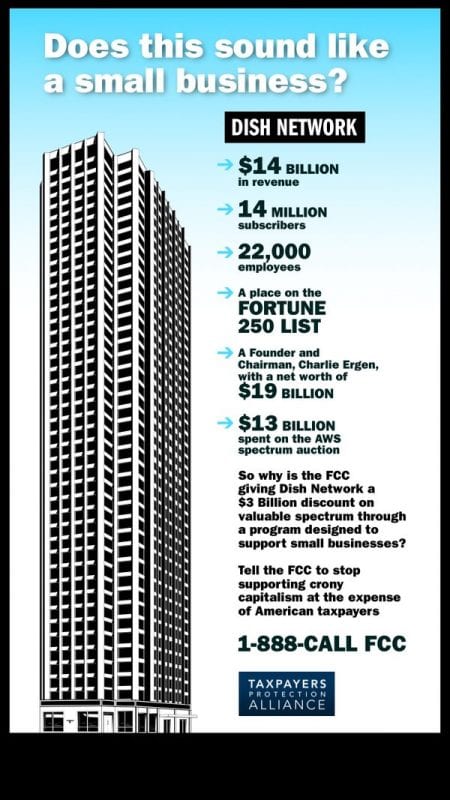
This article orginally apeared on CNBC.com March 16, 2015 Small businesses are undoubtedly the backbone of our economy. We would all agree that more must be done to foster their growth. However, when misguided government efforts to do so lack the appropriate oversight and rules, a few bad acting corporate entities will exploit flawed policies and line their pockets with taxpayer-funded dollars. Satellite provider Dish Network exemplified this when it took advantage of a program designed to help small business win coveted spectrum in a recent auction held by the Federal Communications Commission (FCC). Dish has an 85-percent financial interest in Northstar Wireless and SNR Wireless, two companies that didn't exist until a few months before the auction. Because they have little to no revenue, they qualified as small businesses under the FCC's Designated Entity (DE) program and got a 25-percent bidding credit. They outbid major competitors on countless occasions, and Dish ultimately won about half of the licenses up for grabs – more than $13 billion worth, with a more than $3 billion discount, courtesy of taxpayers. Only AT&T spent more.The end result raises serious concerns about the structure and continued efficacy of the DE program and the FCC's ability to conduct future auctions.

Continue ReadingFCC Needs to Close Auction Loopholes

Don't Bet on Obama's Plan to Drill in the Atlantic

This article originally appeared in The Daily Caller on March 12, 2015 President Obama’s energy policies have been a debacle since his first day in office. Now, with Americans dubious of his schemes after being burned by his war on coal, stifling environmental regulations, and refusal to allow the construction of the Keystone XL pipeline, the president is pulling a new tactic from his bag of tricks in hopes of winning back public support: The old switcheroo. Last month, when the president announced his draconian new policies that would block the production of as much as 30 billion barrels of oil off the coast of Alaska and ban future generations from recovering an estimated 10 billion more sitting beneath Alaska’s Arctic National Wildlife Refuge, he included a trade-off meant to help American energy production efforts elsewhere. Or so it seemed. In his compromise, Obama promised to open up areas of the Atlantic coast from Virginia to Georgia to new opportunities for offshore oil and natural gas leasing … sometime between 2017 and 2022 … maybe. That same area had previously been approved for energy exploration before, but the president killed that plan in 2010. There’s little reason to believe that any drilling will occur in the region this time around, either.

Continue ReadingDon't Bet on Obama's Plan to Drill in the Atlantic