
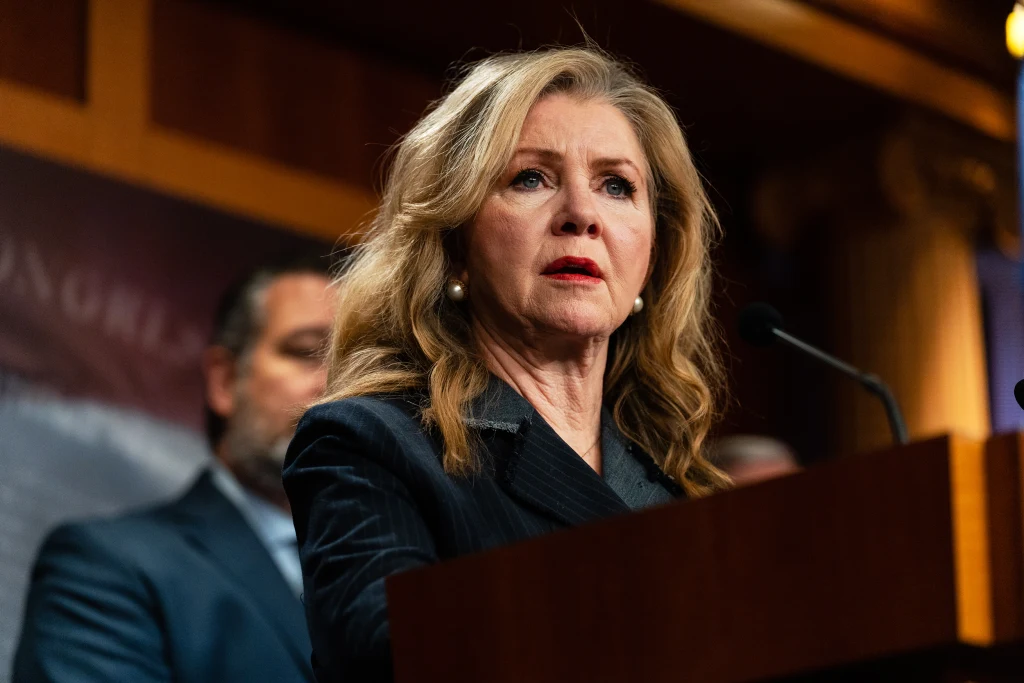
Profile in Cowardice: Sen. Marsha Blackburn (R-Tenn.)
Taxpayers Protection Alliance
April 3, 2026
Every day, Americans benefit from cutting-edge technologies that make their lives significantly easier (and longer). However, even the most promising technologies, such as artificial intelligence (AI), will inevitably encounter political resistance—often ill-conceived and grounded in false information. Democrats have certainly had their fair share of terrible AI proposals that would bury the technology under an avalanche of nonsensical state rules.
Yet one of the most sweeping threats to AI innovation has come not from the progressive left, but from a Republican: Sen. Marsha Blackburn (R-Tenn). Her proposals reflect an excessively timid and fearful view of technology—reminiscent of the safety-obsessed European model—that unreasonably deems technology first and foremost as a threat. For these efforts—which would undermine American leadership in AI and stand in the way of Americans’ access to the digital domain—Sen. Blackburn is a Profile in Cowardice.
Senator Blackburn’s recently unveiled “TRUMP AMERICA AI Act” is billed as a solution to the growing patchwork of state-level AI laws. But behind the rhetoric of “protect[ing] children” and ensuring the U.S. “wins the global race for AI” lies something far more troubling: the proposal is a 291-page blueprint for expansive federal control over one of the most dynamic sectors of the U.S. economy.
Sen. Blackburn’s framework embraces sclerotic and bureaucratic instincts conservatives should oppose without hesitation. It would impose burdensome regulations and red tape on AI that would choke innovation and thereby stifle the development and deployment of new tools with great promise to promote prosperity and save lives.
Her bill would also create a liability free-for-all by sunsetting Section 230, which has been indispensable to the growth of the digital domain. One of the original authors of Section 230, Sen. Ron Wyden (D-Ore.), describes his legislation as both “a sword and shield.” On one hand, it gives online platforms of all sizes a shield from civil litigation for speech they did not create, allowing them to host users’ speech online without fear of legal blowback. On the other, it gives content moderators a sword allowing them to remove potentially harmful posts as they see fit. Section 230 has struck an important balance in helping to develop the internet as we know it, and sunsetting the law would force platforms either to allow their services to become an unmoderated Wild West or to significantly crack down on user speech.
The legislation also bizarrely includes Kids Online Safety Act language, which would impose a vague and onerous “duty of care” for online platforms to prevent undefined harms to minors. It’s unfortunately not surprising that Sen. Blackburn is so intent on heavy-handed regulations that would threaten technological progress. Her co-sponsored Open App Markets Act would undermine consumers’ demonstrated preferences for secure digital platforms and operating systems by forcing app store providers to ditch their carefully-built app vetting processes. Sen. Blackburn’s most recent proposal is simply the latest manifestation of her hostility to innovation.
To be clear, there is a real problem to solve. As AI development accelerates, states have begun crafting their own rules, creating a fragmented regulatory environment that threatens interstate commerce and innovation. For example, New York’s S7263 would impose liability on AI developers when their models give advice on licensed professions (such as law or medicine). This would undermine users’ ability to better understand a doctor’s treatment plan, evaluate a lawyer’s advice, or quickly contextualize the market rate of a contractor’s quote.
But the solution to regulatory chaos is not to replace it with federal overreach. The White House’s own AI framework has emphasized the importance of avoiding overregulation and ensuring that federal policy does not curb growth or innovation. Unlike Blackburn’s trainwreck, the Trump administration has laudably endorsed a single, consistent national standard to facilitate—not micromanage—American innovation.
Besides preemption, the Framework proposes several reforms salutary for innovation. “The United States must lead the world in AI by removing barriers to innovation,” the White House states. It advocates “establish[ing] regulatory sandboxes for AI applications,” “streamlin[ing] federal permitting for AI infrastructure construction and operation,” and, instead of creating “any new federal rulemaking body to regulate AI” per se, allowing “existing regulatory bodies with subject matter expertise” to contend with sector-specific applications of the technology. These measures will expand the sphere of freedom in the digital domain, promoting the development of tools that promise increased general prosperity, new efficiencies for businesses (large and small alike), new medicines and cures for old diseases and disabilities, and much more.
For rejecting this laudable path in favor of byzantine restrictions that would make all Americans worse off—all the while invoking President Trump in the name of her bill—Sen. Blackburn is a Profile in Cowardice. Hopefully, politicians will reject her approach and allow AI to unleash prosperity and growth for generations to come.