
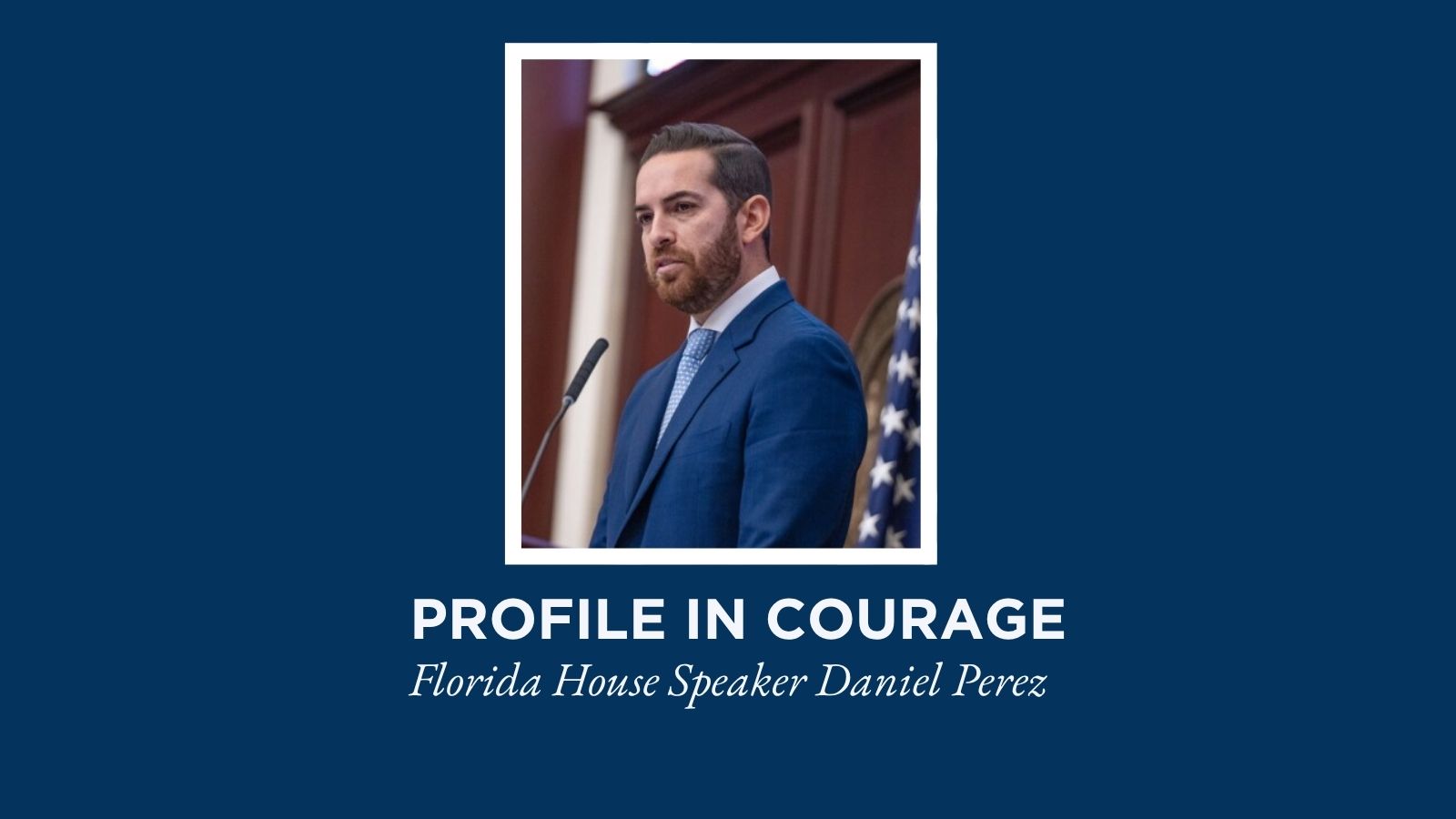
Profile in Courage: Florida House Speaker Daniel Perez
Taxpayers Protection Alliance
May 1, 2026
In an era when artificial intelligence (AI) policy is increasingly driven by fear, political opportunism, and persistent falsehoods, Florida House Speaker Daniel Perez made the critical choice to thwart harmful legislation—Florida’s so-called “AI Bill of Rights.” Made in defiance of Governor Ron DeSantis and during a high-profile special session, that decision will protect innovation and complement President Trump’s proposed national AI framework. For boldly acting against a terrible piece of legislation Speaker Perez is a Profile in Courage.
Championed by Governor DeSantis, the proposed AI Bill of Rights was troublingly broad and vague. The bill sought to extensively regulate chatbot interactions, impose parental consent requirements for minors using AI systems, and restrict how government entities contract with AI providers under poorly defined criteria. Vague rights such as the “right to supervise, access, limit, and control their minor children’s use of artificial intelligence” and the “right to know whether they are communicating with a human being or an artificial intelligence system, program, or chatbot” were tied to a bizarrely broad definition of AI. The legislation defined AI as any “machine-based system that can, for a given set of human-defined objectives, make predictions, recommendations, or decisions influencing real or virtual environments.”
As critics of the legislation pointed out, this catch-all definition risked capturing everything from cutting-edge machine learning tools to routine software systems. Even weather apps could have fallen under the onerous requirements of the bill. Without clear boundaries, the legislation would have created a compliance minefield, especially for startups and smaller developers lacking armies of lawyers. The result would not have been safer AI but less AI—fewer tools and innovative services available to Floridians.
Equally troubling were the bill’s implications for privacy. By mandating a barrage of disclosures and notifications relating to AI deployment, the framework risked encouraging overcollection and overclassification of user data. In attempting to regulate how AI systems interact with different age categories of users, the state would inevitably entangle itself in how information is gathered, processed, and shared. The requirement that companion chatbot platforms prohibit minors “from becoming or being an account holder unless the minor’s parent or guardian provides consent” all but ensures a show-your-papers system in which users would have to submit official government identification or biometric data to verify their ages. That kind of regulatory overreach would pose significant First Amendment concerns and jeopardize the privacy and security of millions of Floridians.
Fortunately, groups such as the Computer & Communications Industry Association (CCIA) pushed back against this terrible proposal. As Tom Mann, State Policy Manager for the South Region at CCIA, noted, “While protecting consumers and addressing risks is important, this legislation takes a broad approach that may not effectively target specific harms. Instead, it risks imposing significant compliance burdens while raising concerns for privacy and free expression.”
Nonetheless, Speaker Perez could have rubberstamped a high-profile proposal backed by the governor and banked the political capital as a crusader for purported AI safety measures.
Instead, on the first day of the special session, Perez made clear that the House would not take up the AI Bill of Rights at all. He explained, “we have seen very clearly the President of the United States issued an executive order stating that the federal government should take handle of the AI policies of this country, that this is a national security concern, that this is bigger than just one state or one part of the country.”
He’s absolutely right. AI innovation has and will transform the country, but that cannot happen if fifty states impose fifty different systems micromanaging the technology from state capitals. As TPA Research Director David McGarry notes, “legislatures of many states—notably in California, Colorado, and New York” have already enacted “an irregular patchwork of heavy-handed and ill-considered regulations that restrain innovators like the hunter’s net in Aesop’s fable of the Lion and the Mouse.” President Trump laudably takes a different approach—one that state lawmakers should respect.
Speaker Perez rightly believes that AI innovation should not be stifled by reams of state-level red tape and that privacy should not be compromised in the name of vague “protections.” For standing firm on those principles, Perez is a true Profile in Courage.