
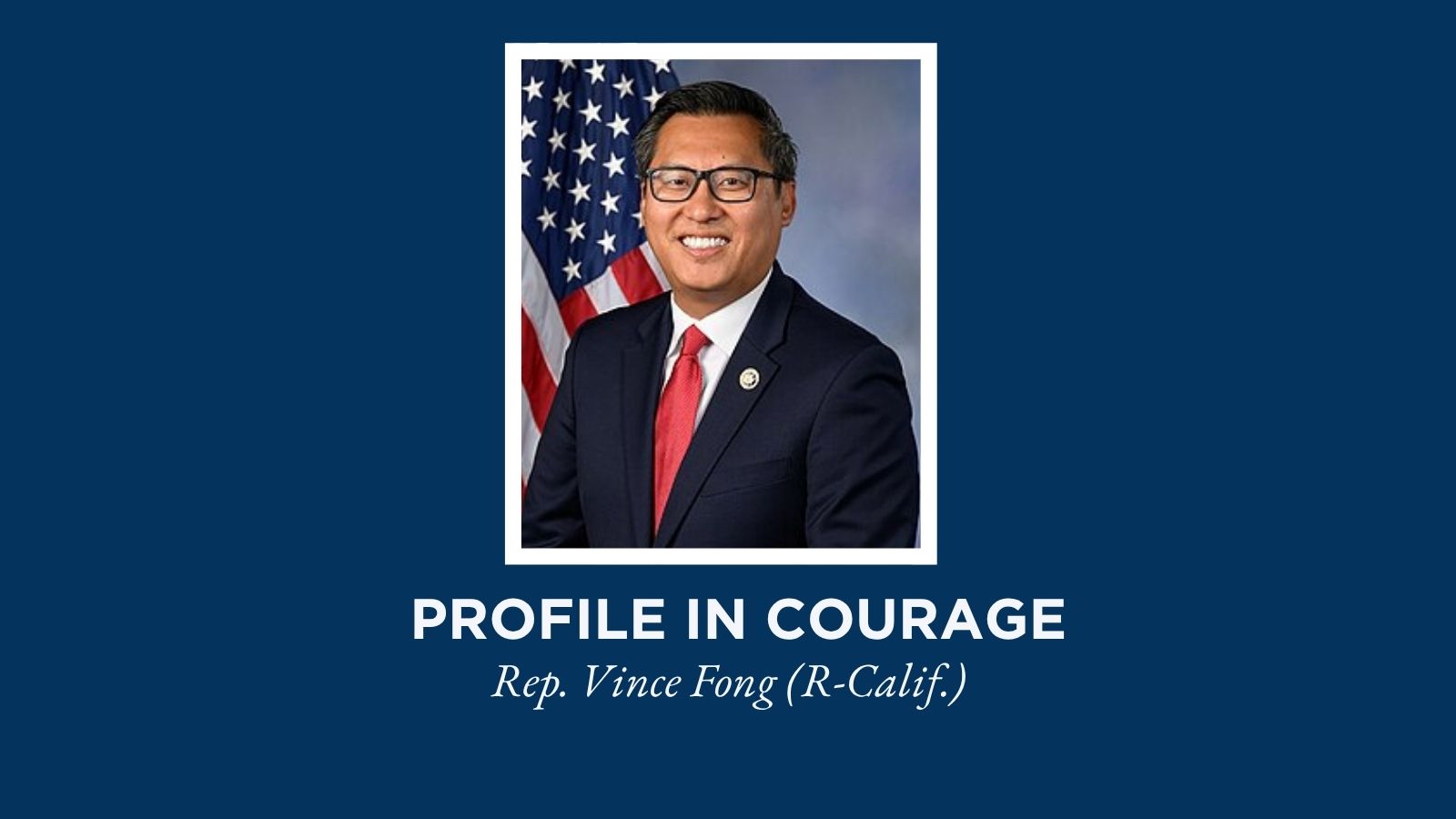
Profile in Courage: Rep. Vince Fong (R-Calif.)
Taxpayers Protection Alliance
May 28, 2026
For years, California residents—and federal taxpayers—have been forced to foot the bill for one of the worst infrastructure boondoggles in American history. A high-speed rail system from Los Angeles to San Francisco was supposed to cost taxpayers “only” $33 billion, but the project is years behind schedule and costs have ballooned by more than 600 percent. Yet, amid the bipartisan instinct to “just keep spending,” Congressman Vince Fong (R-Calif.) has laudably challenged this absurd project and fought for commonsense reforms that would reduce transportation costs across the country. For standing up to his fellow lawmakers eager to turn a $39 trillion debt into fifteen figures of red ink, Rep. Fong is absolutely a Profile in Courage.
Fong’s story is a deeply American one. The son of Chinese immigrants, he grew up in Bakersfield learning firsthand the value of hard work, persistence, and opportunity. He also overcame a childhood speech impediment, an obstacle that would have discouraged many from pursuing a public-facing career. Fong recalls, “I was probably scared to death to speak in front of a group of people, let alone a class. I’ve had teachers and mentors of mine that saw things in me that I didn’t see in myself.” Undeterred, Fong leaned into public service, eventually serving in the California State Assembly before winning election to Congress in 2024.
Upon arriving on Capitol Hill in 2024 and trying to fill the big shoes of former Speaker of the House Kevin McCarthy (R-Calif.), Rep. Fong hit the ground running trying to bring California’s high-speed rail fiasco to a screeching halt.
As the Cato Institute’s Scott Lincicome notes, “California voters first approved a $10 billion bond for the project in 2008, with the understanding that zippy service between Los Angeles and San Francisco would begin in 2020 at a total cost of just $33 billion. Three years past that deadline, however, the project had ballooned in both scope and cost, while not a single piece of track had been laid—even though state, federal, and local taxpayers had already spent at least $13 billion on the project.” Now, cost estimates are north of $130 billion and the CEO of the California High-Speed Rail Authority says it may take twenty more years to complete.
Rep. Fong has laudably demanded transparency, stating, “The high-speed rail nightmare is a glaring example of structural mismanagement. Reckless [and] repeated contract amendments have squandered resources and precious tax dollars. Hardworking California taxpayers cannot afford to let this continue. This project should be canceled before even more money and time are wasted.” In addition, Rep. Fong successfully fought to include a provision in the recently-marked-up transportation bill that would temporarily ban federal funding for California High-Speed Rail and establish a working group to assess its future. Hopefully, this amendment and Rep. Fong’s continued advocacy on the issue will finally derail this failed project.
During the recent transportation mark-up process, Rep. Fong also managed to include an amendment limiting out-of-control liability for ride-share companies. Skyrocketing legal payouts are making everything more expensive, fueling inflation and driving economic anxiety. As reporter Camila Domonoske notes, car insurance premiums are up nearly 50 percent over the past five years, and the increasing cost of accidents is a key contributor. According to Patty Kuderer (insurance commissioner for the state of Washington), “The claims paid really drive the cost of the premiums.”
Congress addressed the issue of lawsuit abuse for rental car and leasing companies in 2005. The Graves Amendment, introduced by House Transportation and Infrastructure (T&I) Committee Chairman Sam Graves (R-Mo.), established a clear national standard: rental and leasing companies should only be held liable for their own negligence, not simply for owning a vehicle. But the exclusion of rideshare apps and “Transportation Network Companies” (TNCs)—which connect riders with drivers on a mass scale—from Graves Amendment language has posed a significant issue for taxpayers and consumers. In the past two decades, the automotive market has been absolutely transformed by the advent of rideshare apps and TNCs.
TNCs have been sued in instances where the driver didn’t even work for a TNC, or when the driver wasn’t on the clock at the time of the accident. TNCs have bizarrely been taken to court even when the driver at fault was an inebriated third-party or ran a red light. While states in general should be in the driver’s seat when it comes to designing their tort systems, legal certainty is sorely needed at the federal level because of the nationwide design and operating model of TNCs. State jurisdictions allowing plaintiffs to sue TNCs when the plaintiff is clearly at fault jeopardize the ride-sharing experience in all jurisdictions. And because TNCs have deep pockets, unscrupulous lawyers will always have an incentive to pursue meritless claims.
Rep. Fong’s amendment wisely protects TNCs from these out-of-control vicarious liability suits and would lower costs for millions of Americans as a result.
Washington is full of politicians eager to praise “investment” regardless of effectiveness and cave to trial lawyers looking for their next payday. It is far easier politically to continue writing checks and back the status quo than to admit existing systems have gone off the rails and need reform. Rep. Fong continues to fight for taxpayers and consumers across the country, and the Taxpayers Protection Alliance applauds this Profile in Courage.