
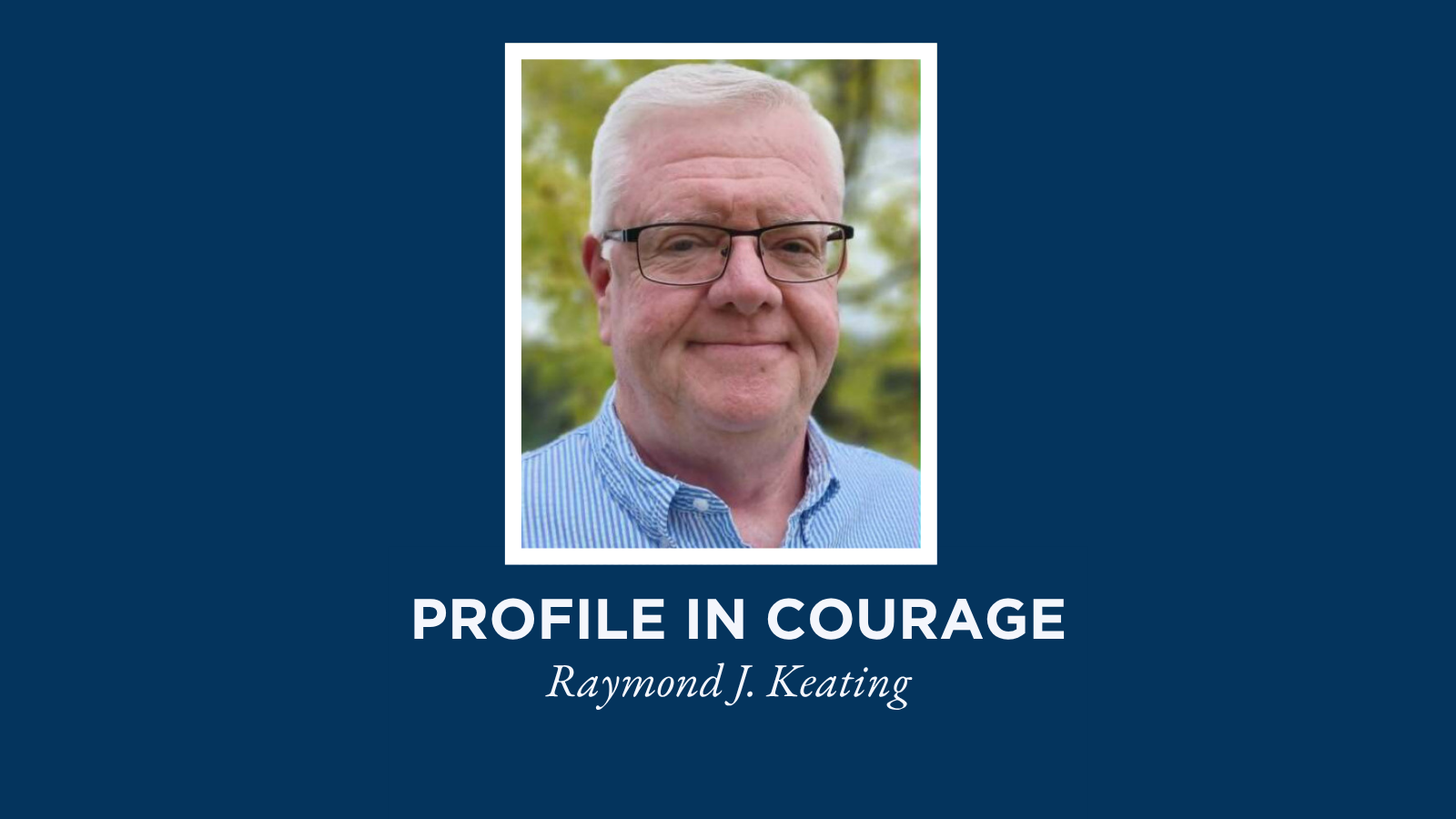
Profile in Courage: Raymond J. Keating
Taxpayers Protection Alliance
July 30, 2026
Thoughtfulness, intellectual vigor, and a consistent commitment to free-market principles are increasingly hard to come by within the Washington, D.C. Beltway—and ought to be celebrated when encountered. D.C. is too often in the grips of thinkers (including those on the populist right) who cheer on endless bureaucratic expansion over economic freedom and individual liberty. The late, great economist Raymond J. Keating, who spent more than three decades advancing free market solutions and advocating for small business owners at the Small Business & Entrepreneurship Council (SBE Council), spent his career proving that a principled defense of free enterprise could transform economic policy. For taking the high road, refusing to yield to tax-and-regulate orthodoxies, and empowering generations of entrepreneurs, Ray Keating was absolutely a Profile in Courage.
For more than 30 years, Ray served as the Chief Economist at the SBE Council, where he became an indispensable voice for the risk-takers and innovators who form the backbone of the American economy. While central planners routinely treat small business owners as piggy banks for new government programs, Ray dedicated his career to dismantling the dangerous myth that central planning results in prosperity. In January, he eloquently noted, “Free enterprise is a dynamic system in which the only real constant is change. That is, businesses and industries are created, grow, innovate, die and are completely transformed. Entrepreneurs and small businesses, of course, are central to this process. They are the primary innovators, disruptors and transformers. They also tend to be quick to recognize how innovations and changes brought about by enterprises in other sectors can and do help their own businesses.”
Through hundreds of analyses, congressional testimonies, and national op-eds, Ray consistently demonstrated that economic growth hinges on lower tax burdens, light-touch regulation, robust intellectual property rights, accessible energy markets, and open trade. While the alternative of heavy-handed government intervention often tempts policymakers, he consistently cautioned against such an approach: “Regulation always carries a cost. In the best-case scenario, the benefits of a regulatory measure outweighs the costs. Unfortunately, more often than not, that’s not the case. But it’s even worse when regulations are imposed without any consideration of how the market operates, including the fact that change is a constant and that the costs of regulation spread beyond the firms targeted by such regulation.”
Ray knew that federal policies do not operate in a vacuum—they directly impact local main streets and state economies. Through his comprehensive economic reviews, including U.S. by the Numbers and New York by the Numbers, Ray exposed how high-tax and interventionist state regimes drive away capital, stifle innovation, and spark population flight. His rigorous data-driven approach held lawmakers accountable and equipped taxpayers with the facts needed to challenge harmful state and federal mandates. He was even instrumental in helping the Taxpayers Protection Alliance (TPA) hit the ground running in 2011—our first year. TPA President David Williams cited Keating’s work in making the point that taxpayer-funded broadband boondoggles do nothing to bridge the digital divide. Some things never change.
Small business was top of mind for Ray and the good folks at the SBE Council when they, alongside TPA, successfully urged for tax reform in 2017. SBE Council provided a critical voice to small businesses who knew that tax reform was necessary.
Beyond his economic scholarship, Ray brought an abundance of warmth and wide-eyed curiosity to the liberty movement. He was an educator, a long-time columnist, and a prolific novelist who authored the popular Pastor Stephen Grant mystery series. Ray possessed the unique ability to connect economic philosophy to daily life, culture, and personal responsibility, always reminding his audience that economic freedom is fundamentally about human flourishing and moral clarity.
Ray’s intellectual courage was defined by his eagerness to stand firm for free enterprise, even as big-government interventionism has dominated the political landscape. He understood what central planners constantly ignore: when government burdens small businesses with taxes and red tape, it punishes the very dreamers who power American growth. Though Ray passed away far too soon, his vast body of work and unwavering legacy remain an enduring beacon for taxpayers and defenders of free markets. Ray Keating was a once-in-a-generation champion for a freer, more prosperous world, and he will be missed dearly.