
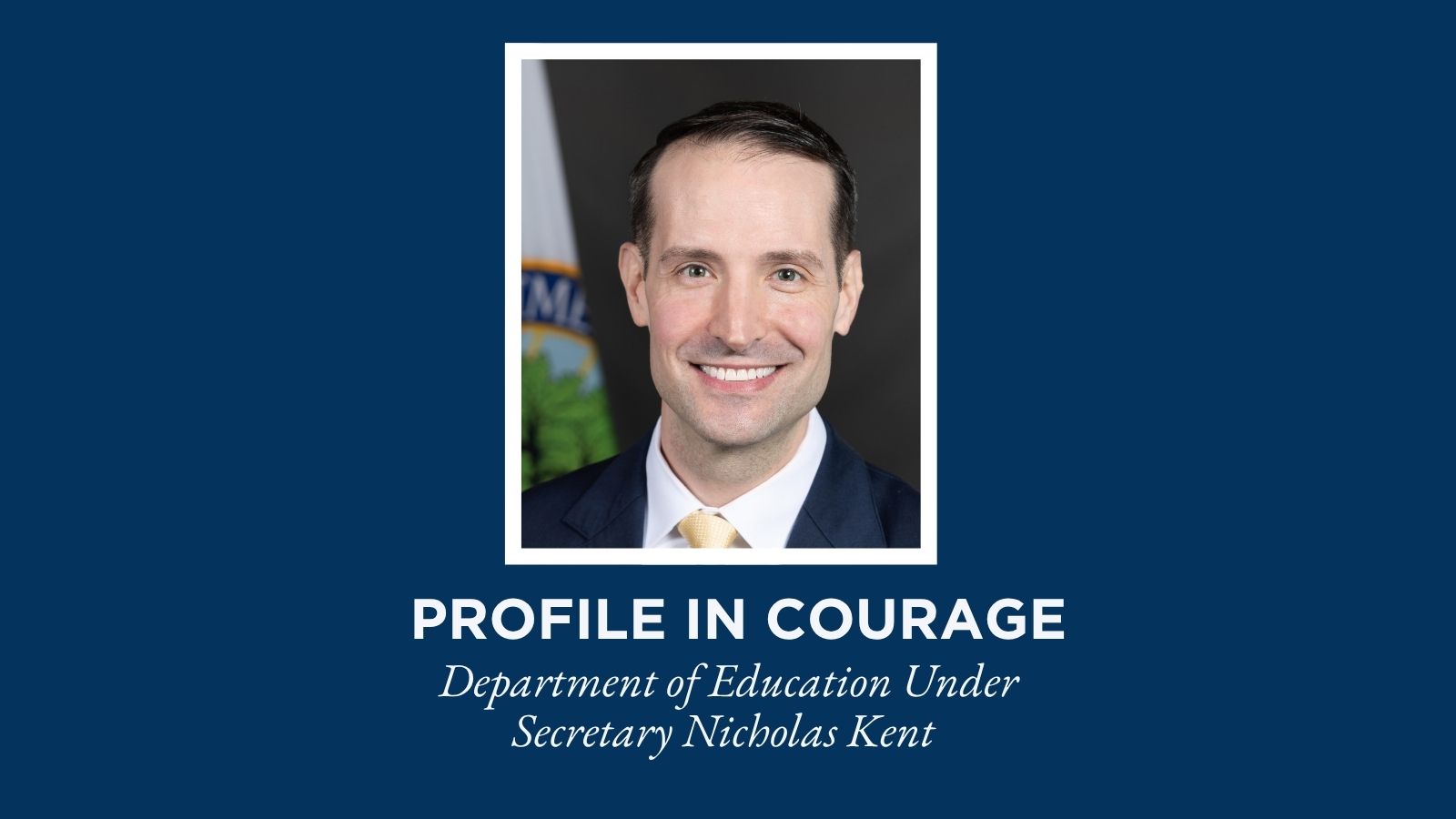
Profile in Courage: Department of Education Under Secretary Nicholas Kent
Taxpayers Protection Alliance
May 1, 2026
At a time when America’s higher education system is buckling under the weight of rising costs, plunging enrollment, and declining public trust, meaningful reform is long overdue. For years, policymakers have papered over structural problems with costly promises and blatantly unconstitutional actions to deliver said promises, leaving students and taxpayers to foot the multi-hundred-billion dollar bill. Fortunately, public officials such as Department of Education (ED) Under Secretary Nicholas Kent are reversing this sorry status quo and ensuring that federally backed loan programs, along with the higher education system on the whole, are accountable to taxpayers and consumers. Working alongside President Trump and Education Secretary Linda McMahon, Kent has taken on the difficult task of restoring accountability and functionality to a higher education system that too often prioritizes bureaucracy over student success. And for undertaking these efforts even as critics irresponsibly decry “cuts to higher education,” Nicholas Kent is absolutely a Profile in Courage.
One of Kent’s most consequential efforts has been confronting the surge in financial aid fraud that flourished under years of weak oversight and pandemic-era policy blunders. Fraud schemes exploiting online enrollment systems and emergency flexibilities have drained federal resources and undermined trust in the system. For example, Fox News recently reported, “Ghost students are a growing trend involving fabricated or stolen identities, often powered by AI bots or criminal networks using real Americans’ personal information, used to enroll in programs, trigger financial aid disbursements, and then disappear.”
In response, Kent has pushed for targeted reforms, such as strengthening verification processes, improving coordination with state agencies, and enhancing data-sharing between institutions and enforcement partners. For example, ED recently rolled out a Free Application for Federal Student Aid (FAFSA) identity verification measure which “screens and assesses each applicant for risk of identity fraud in real time as they fill out the form. … flagged applicants whose ID is denied or who cannot provide verification on the spot will have their Institutional Student Information Record rejected.”
As Under Secretary Kent points out, though, these reforms—which saved taxpayers more than $1 billion in fiscal year 2025—are only the start of a comprehensive effort to restore integrity to the higher education system. Until the federal government fully scrutinizes “the enormous amount of fraud, waste and abuse” happening in states such as California and Minnesota, taxpayers will continue to pay the price. Education Secretary McMahon and Under Secretary Kent will continue to ramp up efforts to ensure that taxpayer dollars are not being squandered or stolen. And thanks to new initiatives such as the Workforce Pell Grant program, saved taxpayer dollars can go further to support career-focused paths than ever before.
Beyond fraud prevention, Kent has taken on a quieter but equally important challenge: leveling the regulatory playing field. As the Taxpayers Protection Alliance (TPA) has repeatedly documented, education bureaucrats have too often been picking winners from losers and punishing education programs—especially private ones—it doesn’t like. Fortunately, after a negotiated rulemaking process with multiple stakeholders, ED has decided that all education programs will be held to the same standard in determining whether they’ll receive taxpayer support.
Newly agreed on language by ED “treats all programs – from certificate to graduate programs – equally. Under the proposed framework, institutions will lose access to the Direct Loan program if they fail to meet the relevant earnings thresholds for two out of three years.” This is a significant improvement from the previous status-quo implemented under the Biden administration. The 2023 “Financial Value Transparency and Gainful Employment” rule applied onerous standards to “nearly all educational programs at for-profit institutions of higher education, as well as non-degree programs at public and private nonprofit institutions such as community colleges.” To receive federal loan dollars from taxpayers, covered programs had to demonstrate that graduates increase their earnings (compared to high school graduates) and aren’t straddled with high debt as a percentage of their income. The Biden administration implemented this in a profoundly strange and unfair manner by not applying the same accountability metrics to non-profit institutions offering four-year programs, even though these programs are typically far larger and at the core of the issues facing higher education. Education Secretary McMahon and Under Secretary Kent deserve the lion’s share of the credit for working toward a fairer system that benefits all students while delivering real accountability, while moving against outdated and unfair regulations such the deeply-flawed 90-10 rule.
In addition, Under Secretary Kent is working to “simplify the Secretary’s recognition of emerging and existing accreditors [and] examine the extent to which accreditation contributes to rising higher education costs and credential inflation.” This is key because onerous accreditation processes lead “the average college to incur more than $300,000 in direct and indirect costs,” most of which is passed along to students.
Nicholas Kent stands out for his tireless commitment to students and addressing the many problems facing the American higher education system. His work is helping to put a deeply troubled system on a more stable and accountable path. For bringing bold leadership to the Department of Education, Under Secretary Nicholas Kent is a Profile in Courage.