
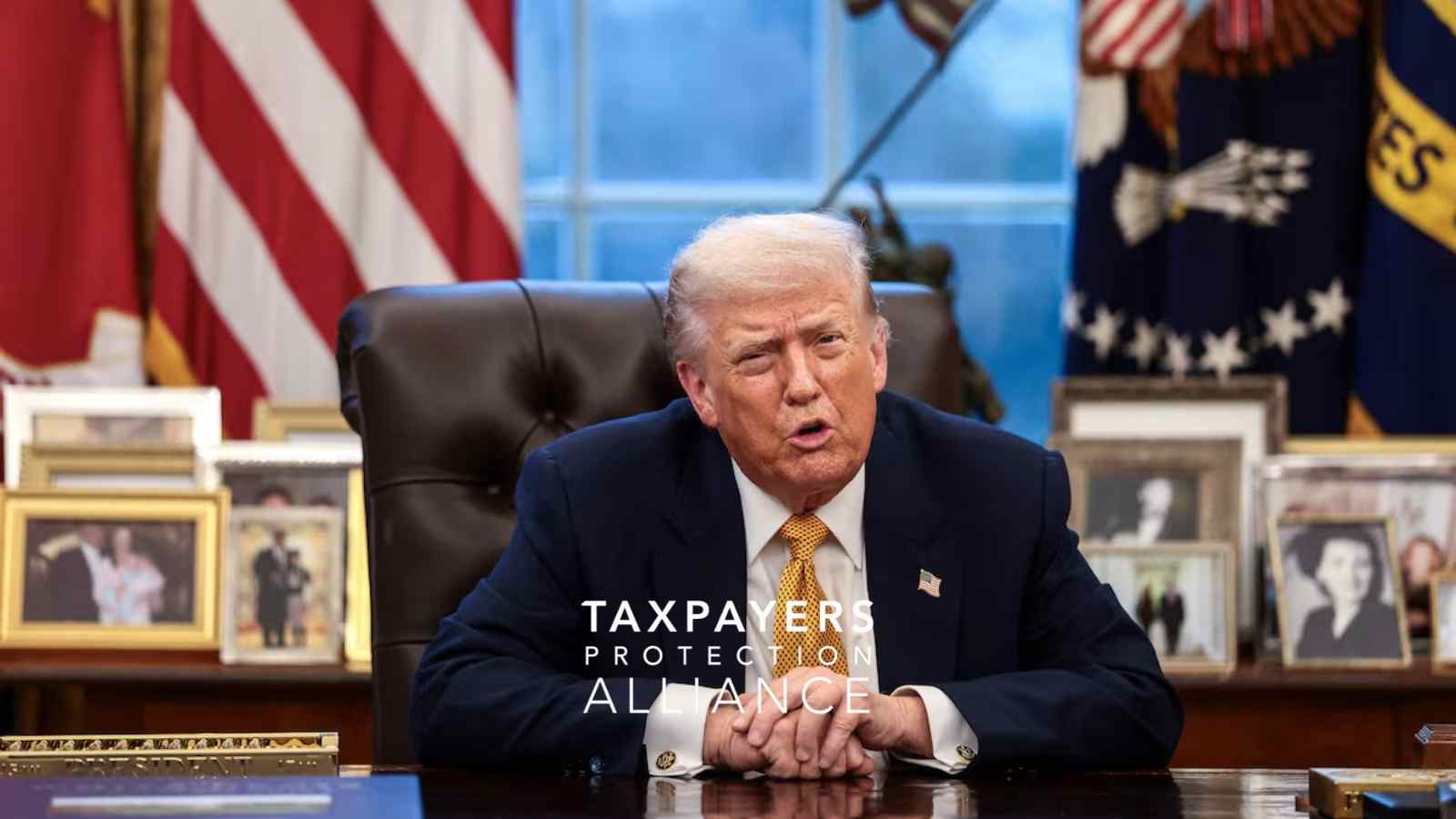
A Mixed Bag for Taxpayers in President Trump’s State of the Union
Taxpayers Protection Alliance
February 25, 2026
President Trump had plenty to say during last night’s nearly two-hour long State of the Union address. Among other things, he slammed the recent Supreme Court ruling on tariffs, defended his record on tax reform, called for a ban on institutional investors owning homes, doubled down on price controls for drugs, and even announced a “war on fraud.” While some of the President’s rhetoric should give hope to limited government advocates, other statements reflect an executive who is all-too eager to expand bureaucracy and use government to solve problems (and nonproblems). Below, the Taxpayers Protection Alliance takes a deep dive into President Trump’s address:
President misses the mark on housing investments.
“[L]ast month I signed executive order to ban large Wall Street investment firms from buying up in the thousands, single-family homes. And now I’m asking Congress to make that ban permanent because homes for people — really, that’s what we want. We want homes for people, not for corporations.”
Along with left-wing lawmakers such as Sen. Elizabeth Warren (D-Mass.), the Trump administration seems to believe that banishing large institutional investors from the housing market would magically lower home prices. The problem is there’s no evidence to support that idea.
According to a recently released analysis by the American Enterprise Institute, “[l]arge institutional investors (100+ properties) own roughly 1 percent of the single-family 1–4 housing stock.” Most investors are small and own less than 10 properties. Targeting so-called “Wall Street investment firms” fails to address the crux of the housing affordability problem, which has far more to do with onerous land use regulations (e.g., zoning) than investment strategies.
Rather than doubling down on this misguided crusade against investors, President Trump, Congress, and state and local lawmakers should focus on cutting red tape.
Drug price controls would lead to significant shortages.
“Under my just enacted Most Favored Nation agreements, Americans who have for decades paid by far the highest prices of any nation anywhere in the world for prescription drugs will now pay the lowest price anywhere in the world for drugs, anywhere, the lowest price.”
The “Most Favored Nation” (MFN) approach, in which the government forces drug prices lower to bring prices in line with other countries, may sound promising on paper. But price controls lead to shortages and diminished innovation wherever and whenever tried, and MFN would have the same failed result.
To see this impact in action, look no further than the government’s current drug price control policies implemented under President Biden, via the 2022 Inflation Reduction Act (IRA), which have been continued under President Trump. As economist Tomas J. Philipson noted in The Wall Street Journal, “About 42 [percent] of the 184 cancer therapies that were initially approved during [the 2000-2024] period had follow-on approvals—involving new uses or ‘indications’ for an existing drug—such as treating additional cancer types or being used earlier in the disease, when treatment outcomes tend to be better.” This follow-on progress “is a big driver of new cancer treatments, the largest drug class making up about 35 [percent] of the overall FDA pipeline” but sustained research and associated funding are drying up because of price controls. Following IRA implementation, “companies have halted at least 55 research programs and given up 26 medicines.” Enacting yet another price control through an MFN program would only make the situation worse.
To actually lower drug prices, President Trump should work with Congress to streamline the broken drug approval process at the Food and Drug Administration and build on recent reforms addressing pharmacy benefit managers.
The “War on Fraud” and entitlement reform are long overdue.
“But when it comes to the corruption that is plundering — really, it’s plundering America. There’s been no more stunning example than Minnesota. … And California, Massachusetts, Maine and many other states are even worse. This is the kind of corruption that shreds the fabric of a nation, and we are working on it like you wouldn’t believe. So, tonight, although started four months ago, I am officially announcing the war on fraud to be led by our great Vice President, JD Vance.”
“[U]nder this administration, we will always protect Social Security and Medicare. They are not protecting it for our seniors.”
President Trump and Vice President Vance are absolutely right to focus on fraud. A viral social media video by YouTuber Nick Shirley exposed a massive fraud scheme in Minnesota in late December 2025, involving federal and state aid programs that were abused and from which funds were stolen. While Shirley directed the focus of his investigation toward childcare centers that didn’t actually care for children, a variety of taxpayer-funded programs in Minnesota—including autism centers and non-emergency medical ride services for the elderly—have also been defrauded.
Additionally, the scale and extent of the fraud highlight the urgent need for reforming Medicaid, which was also targeted by Minnesota fraudsters to the tune of $9 billion. The national program lacks sufficient oversight, exposing taxpayer dollars to potential fraud, waste, and abuse. One major issue with Medicaid, which is jointly financed by states and the federal government and administered by states, is that eligibility criteria are lax and affluent Americans are benefitting from a program that is supposed to be for low-income households.
When considering eligibility for long-term care services, multiple states turn a blind eye to multi-million dollar homes and padded retirement accounts, which are often considered “non-countable” assets when either in the applicant or spouse’s name. Given that Medicaid long-term care spending is about one-third of the program’s $1 trillion budget and quickly growing, the Trump administration and Congress need to address this issue immediately and build on the One Big Beautiful Bill Act’s (OBBBA’s) promising—albeit limited—eligibility reforms.
And given that Social Security and Medicare are only eight years away from insolvency, any fiscal reforms must address these programs as well. Commonsense reforms such as increasing the Medicare age, means-testing program benefits, and cracking down on improper payments can save taxpayers significant amounts of money.
Tax changes have been a mixed bag for taxpayers.
“Last year, I urged this Congress to begin the mission by passing the largest tax cuts in American history and our Republican majorities delivered so beautifully. … we held strong and with the Great Big, Beautiful Bill, we gave you no tax on tips, no tax on overtime and no tax on Social Security for our great seniors.”
While President Trump touted the OBBBA during his speech, the bill was a mixed bag for taxpayers and consumers. Most importantly, the legislation made permanent some of the landmark temporary provisions in the Tax Cuts and Jobs Act (TCJA). For example, it extends TCJA’s lower marginal income tax rates, extends and increases the standard deduction, caps or limits various itemized deductions, expands business expenses qualified for expensing, and increases the thresholds of assets considered under estate and gift taxes, among other measures. The key success of the TCJA was that it brilliantly simplified the tax code while providing significant tax relief for both businesses and individuals, fueling economic growth and improving taxpayers’ quality of life. The OBBBA builds on that success—at least partially.
However, the introduction of provisions like no tax on tips, overtime, or Social Security are gimmicks and unnecessarily add more complexity to the tax code, in direct contradiction of the objective of the TCJA. And critically, the OBBBA passed up a generational opportunity to reduce the debt. Even with the law’s modest cuts, Medicaid spending will still grow dangerously fast and other trillion-dollar programs such as Medicare remain untouched. Unless Congress and President Trump take up fiscal reform, all Americans will pay the price.
Tariffs are taxes.
“Countries that were ripping us off for decades are now paying us hundreds of billions of dollars. … They’re not making money like they used to but we’re making a lot of money. … And then just four days ago, an unfortunate ruling from the United States Supreme Court, it just came down. It came down, very unfortunate ruling.”
Here, the President is referencing the recently decided Learning Resources, Inc. v. Trump case, in which the Court held that the International Emergency Economic Powers Act does not authorize the President to impose tariffs—contrary to White House claims. This ruling is far from unfortunate.
The White House’s tariff policy amounted to an attempt to discover never-before-seen powers to remake the international trade order based on a few (misread) words in the decades-old statute. Just as the Supreme Court refused to stand by when former President Biden attempted to lay claim to essentially legislative powers, it would not stand by as the Trump administration attempted a similar project. Under the Constitution, the power to set the tariff rate is vested in Congress, and nothing in the statute relied upon by President Trump transferred those powers to the White House.
In addition to constitutionality concerns, tariffs are nothing more than import taxes levied on consumers. According to an analysis by the Tax Foundation, tariffs cost the average U.S. household $1,000 in 2025, and that total will grow in 2026 if President Trump defies the Court. Let’s hope that doesn’t happen.
Congressional insider trading needs to end.
“Pass the Stop Insider Trading Act without delay.”
Needless to say, this should have happened a long time ago. The leadership of both parties has hindered the passage of this legislation, entrenching a deeply unfair status quo. Members of Congress have a unique ability to influence the direction of both the American economy and the global stock market. As such, they also possess the tremendous ability to vote in accordance with what’s best for their personal stock portfolios, rather than the public interest. The continued practice of congressional stock trading has eroded public trust, as 86 percent of Americans now support an outright ban on the practice. It’s long past time to act.
Conclusion
Even though the speech was fairly light on policy specifics, the ones that were highlighted show a Republican party increasingly shifting away from limited government principles and toward populism. The biggest missed opportunity was addressing the $1.8 trillion deficit and $38 trillion debt. Last year, the talk of the town was DOGE and the trillions of dollars that would be identified as wasteful spending.
Despite some progress in reducing the federal workforce, DOGE did not deliver on solving America’s fiscal issues—a job that Congress needs to take the lead on. President Trump and lawmakers need to end Washington’s addiction to spending and commit to the small government ideals that made America the shining city on a hill.