Read more about the article Taxpayers Funding ‘Business As Usual’ Corruption At Fannie Mae
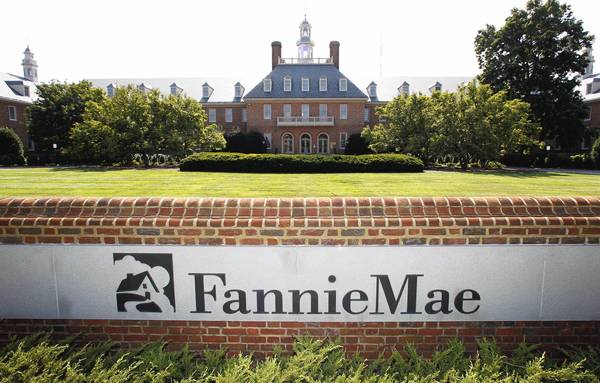
FILE - In this Aug. 8, 2011, photo, the Fannie Mae headquarters is seen in Washington. The House Financial Services subcommittee on capital markets holds a hearing on the structure and costs of Fannie Mae and Freddie Mac on Wednesday, May 15, 2013. (AP Photo/Manuel Balce Ceneta, File) ** Usable by LA and DC Only **

Taxpayers Funding ‘Business As Usual’ Corruption At Fannie Mae

Fannie Mae, DC HQ (Manuel Balce Ceneta, AP/ August 8, 2011) In July 2008, before the height of the 2008 Financial Crisis, the United States Government began to consider a federal takeover of Fannie Mae should the housing market further deteriorate. Just a few short months later, that’s exactly what transpired and in "one of the most sweeping government interventions in private financial markets in decades," the Federal Housing Finance Agency announced that Fannie Mae (and Freddie Mac) would be placed into conservatorship. Shortly after, the mortgage giant received ataxpayer-funded bailout to the tune of $116 billion and after more than four years the American taxpayer still hasn’t been fully compensated, and the housing market remains clouded with uncertainty. Fannie Mae is the nation’s biggest buyer of home loans and guarantor of mortgages bundled for sale to investors and now a story out Monday, May 27th, reveals major allegations of corruption at the government-run Fannie Mae. The details that have emerged make it almost impossible for anyone to be pleased with the fact that this is an organization that is operating at the cost of the taxpayer and what they allegedly are doing with the money they’ve been given is nothing more than corruption of the worst kind. The Los Angeles Times, in an article titled “Kickbacks as 'a natural part of business' at Fannie Mae alleged” details how “investigators are now looking into assertions” by former Fannie Mae employees that kickbacks were "a natural part of business" at the government-sponsored entity. Armed with information coming from wiretapped conversations and a sting operation, investigators allege Fannie Mae Foreclosure Specialist Armando Granillo demanded a 20% cut of commission amounting to an illegal kickback for steering foreclosure listings to brokers.


Continue ReadingTaxpayers Funding ‘Business As Usual’ Corruption At Fannie Mae

A La Carte Gives Consumers Less Choice At A Higher Cost

Photo courtesy of Dwight Burdette With much attention in Congress focused on the Farm Bill, Marketplace Fairness Act, and Immigration there are some issues that fly under the radar. One such issue that is experiencing a renewed push is the call for government-mandated "A la carte" programming. Introduced by Sen. John McCain (R-Ariz.), The “Television Consumer Freedom Act,” which would pressure cable companies to provide “a-la-carte” programming, would change the way in which cable providers do business. The legislation is designed to force cable television providers like Verizon and Comcast to alter their pricing and plans in an effort to provide "greater choice" and lower cost to customers who don't want to pay for a bundle that includes hundreds of channels they may or may not want. In bringing this legislation to the forefront, he stated that it "is about giving consumers more choices when watching television." In reality, “a-la-carte” programming is bad for the consumer and not an issue that an already over-burdened Congress should be wasting time on. Sen. McCain was one of the original proponents of “a la carte” legislation going back nearly a decade ago, but at some point his push faded... but now it appears to have made a comeback and he is once again turning his sites on getting an “a la carte” pricing bill through Congress. Sen. McCain continues to argue that passing this legislation would lower the price for consumers and allow them to have greater choice over the services they purchase. Nearly a decade ago, the U.S. Government Accountability Office said that moving to “a la carte” could potentially "cost providers advertising revenues that would result in an increase in subscriber fees." The cost isn't the only thing that would be adversely impacted, the notion of "choice" also would be in danger.

Continue ReadingA La Carte Gives Consumers Less Choice At A Higher Cost

The Senate’s Bad Apple: Why Congress Should Focus on Tax Reform Instead of Vilifying Businesses

Apple HQ (courtesy Joe Ravi) The Senate Permanent Subcommittee on Investigations thought it would be a good exercise to spend time, and taxpayer money, yesterday hauling in Apple executives Chief Executive Officer Tim Cook, Chief Financial Officer Peter Oppenheimer and Apple’s head of Tax Operations Phillip Bullock to question them about a report from the Subcommittee that says Apple kept billions in profits in Irish subsidiaries to pay little to no taxes to any government. Mr. Cook and the other witnesses representing Apple during yesterday’s hearing strongly rebuked charges that they did anything wrong or used any “gimmicks” in an effort to avoid paying what they owed in taxes, stating that “We pay all the taxes we owe, every single dollar” adding the company doesn’t "stash money on some Caribbean island." In fact, Mr. Cook went further, presenting his own recommendations for reforming the complicated tax code including a reduction in the corporate tax rate suggesting a "dramatic simplification," with an overhaul that should be “revenue neutral, eliminate corporate tax expenditures, lower overall tax rates and make it easier to bring money back from overseas.” The real story here isn’t about a major corporation that follows the law and does exactly what is best for their company and their shareholders, but the fact that the tax code needs a complete makeover. In particular, yesterday’s hearing showed that corporate tax reform should be at the top of the list for reform. The Taxpayers Protection Alliance has been a strong advocate of reforming the tax code and simplification of the way both individuals and businesses file their taxes.

Continue ReadingThe Senate’s Bad Apple: Why Congress Should Focus on Tax Reform Instead of Vilifying Businesses

No California Love For Taxpayers With Latest Attempt At Tax Increases

The California State Legislature is moving a bill (SB 768) that will raise the tobacco tax in the state by $2, and the proposal is gaining momentum and could become law very soon. The bill was introduced by Senator Kevin de León (D-Los Angeles) last month, and while it comes under the heading of “raises revenues for health programs", the fact is this bill will hurt the California economy, hurt California businesses, hurt California consumers, and hurt California taxpayers. The usual excuse for this type of tax increase is to generate some amount of increased revenue for a state funded program almost always related to health care, seeing as it is targeted directly at those who smoke. The state of California has already tried this type of scheme before to "raise revenue" and the fact of the matter is this is not the responsible way to go about it, especially when you consider that the revenue raised from the cigarette tax in California has decreased. Unfortunately, revenue expectations from tobacco taxes tend to be Fool’s Gold. The Minnesota State News pointed out that “Since 2003 there have been 57 cigarette tax increases across the nation and 68% of them have failed to meet projected revenues. In 2006, New Jersey raised cigarette taxes with the hope of pulling in $30 million in extra revenue each year. Not only did the tax hike fail to bring in extra revenue, but the state actually collected $20 million less in cigarette sales.”

Continue ReadingNo California Love For Taxpayers With Latest Attempt At Tax Increases

Minnesota Democrats Gone Wild With Tax Increases

(David Strom, a Minnesota resident, is principal at Think Write Do, a public affairs and marketing consulting firm, and Taxpayers Protection Alliance (TPA) Research Fellow.) Minnesota has a reputation as a bastion of liberalism, but for most of the past 2 decades that reputation has not reflected the reality of politics on the ground here. Sure, my state has produced notable liberals such as Senator Paul Wellstone, but until 2010 no Democrat (we call them the Democrat-Farmer-Labor party here) had been elected governor since 1990, when Rudy Perpich left office. Perpich, it should be said, set the goal of reducing taxes and taking Minnesota out of the top 10 states in tax rates, a goal that was finally met by Tim Pawlenty during his two terms in office. All that changed in 2010, when true blue liberal Mark Dayton (heir to the Dayton department store fortune) was elected governor in 2010, and Dayton has made it his mission to get Minnesota back into the top rankings of high tax states. As soon as the Democrats took full control of state government, Dayton proposed increasing sales taxes on both consumer and business-to-business transactions, as well as raising income taxes on “the wealthy” and businesses. He also proposed a 3-year “temporary” income surcharge for incomes over $500,000, raising the effective tax rate on those earners to over 13%. The Democrats have proposed hefty increases on both cigarettes and alcohol, even touching a third rail in Minnesota politics—an increase in taxes on beer. Cigarettes would see an additional tax of $1.60 a pack, making the working class pastime of having a smoke with a beer a substantially more expensive pleasure. Even taking a shower after a hard day’s working, drinking, and smoking will cost more, as fees for water will increase.

Continue ReadingMinnesota Democrats Gone Wild With Tax Increases

TPA Calls for Release of IRS E-mails Between Cincinnati and Washington, D.C.

Taxpayers Protection Alliance President David Williams issued the following statement in the wake of the Internal Revenue Service scandal, calling on the Obama Administration to release all e-mails between the Cincinnati IRS field office and the Washington, D.C., office. “Late last week we learned that the Internal Revenue Service was engaged in the inappropriate and possibly criminal targeting of non-profit groups based on their political ideology. We have subsequently discovered that these actions were known to be happening by officials in Washington. The abhorrent practices documented by an Inspector General’s report released this week reveal that IRS Agents selectively targeted nearly 500 groups simply for political reasons, completely disregarding the standards and guidelines that have been clearly laid out for these processes. There is no place for this kind of behavior at an agency as powerful as the IRS and it only serves as a reminder of the ways in which the federal government can abuse their power without the proper oversight. TPA is calling on the Obama Administration to force the release of all e-mails between the Cincinnati IRS field office and the Washington, D.C. IRS headquarters that relate to employees singling out groups for added scrutiny that have names like 'Tea Party' or 'Patriot' and groups that educate about government spending or the Constitution."

Continue ReadingTPA Calls for Release of IRS E-mails Between Cincinnati and Washington, D.C.

New Environmental Standards Losing Favor With Federal Agencies

For the past year the Taxpayers Protection Alliance (TPA) has been investigating the Leadership in Energy and Environmental Design (LEED) green building certification system, which inflates the cost of construction by millions of dollars per building without providing proof of any environmental or energy-efficiency benefits. Since 2010, the General Services Administration (GSA), the federal government’s landlord, has mandated LEED gold standards for all new federal buildings. The federal government, 35 states and over 170 cities now require LEED certification or give builders tax breaks for building to LEED specifications. The driving force behind LEED is the United States Green Building Council (USGBC), a 13,000-member non-profit run by activists, architects, builders and building suppliers that collects up to $35,000 in fees for each LEED certification.

Continue ReadingNew Environmental Standards Losing Favor With Federal Agencies

TPA Sends Letter Urging House Agriculture Committee to Reject RUS Broadband Loan Program Amendment

As the Taxpayers Protection Alliance (TPA) continues to follow developments on the Farm Bill, including the bill clearing the Senate Agriculture Committee yesterday, TPA President David Williams sent a letter to the House Agriculture Committee yesterday in response to a proposed amendment weakening oversight of the wasteful Rural Utilities Service Broadband Loan Program. The letter outlines opposition to the program and calls on the committee to reject an amendment offered by Rep. Chris Gibson (R-N.Y.) and Rep. Kurt Schrader (D-Ore.) further providing taxpayer funding to a program rife with problems. When it comes to wise use of taxpayer dollars, RUS has a troubled history. RUS's primary goal is to provide loans to help bring Internet broadband service to unserved rural communities, which are generally defined as communities with populations of less than 20,000. In a March, 2009 report by the U.S. Department of Agriculture's (USDA) Office of Inspector General (OIG) observed that while the 2008 Farm Bill modified the broadband program and narrowed the definition of "rural area," the RUS continued to issue loans in exurban and suburban areas. Also, according to a report by the USDA on April 23, 2012, "We found that RUS had not maintained its focus on rural communities most in need of Federal assistance. This is largely because its definition of 'rural area,' although within the statutory guidelines, was too broad to distinguish between suburban and rural communities. As a result, RUS issued over $103.4 million in loans to 64 communities near large cities." TPA will continue to monitor this and other provisions in the Farm Bill. To see the full letter, click read more below

Continue ReadingTPA Sends Letter Urging House Agriculture Committee to Reject RUS Broadband Loan Program Amendment

TPA Joins Coalition to Oppose Sugar Subsidies

As the House and Senate ramp up their work on the Farm Bill, the Taxpayers Protection Alliance (TPA) will be in high alert so taxpayers won’t be left with a laundry list of wasteful programs that have amounted to nothing more than cronyism and corporate welfare run amuck. One issue in particular that is emblematic of what is wrong with agricultural policy is the U.S. sugar program, which is prime for reform. From import quotas to purchasing excess sugar to keep prices artificially high, the sugar program is just one massive corporate welfare program. Led by the Competitive Enterprise Institute, TPA was proud to sign onto a letter with nine other taxpayer and free market organizations opposing sugar subsidies. To read the full letter, click read more below

Continue ReadingTPA Joins Coalition to Oppose Sugar Subsidies

TPA Joins Coalition To Oppose Wasteful and Costly Farm Bill

Led by Heritage Action For America, the Taxpayers Protection Alliance joined with other taxpayers and free-market organizations representing millions of individuals across the nation to oppose wasteful spending in the Farm Bill. The Senate and House appear ready to start legislative work on the Farm Bill as early as this week, and it is important to call attention to the habitual waste of money that has become too commonplace in the Farm Bill. There is tremendous need for reform. Current subsidy programs are rooted in the 1930s, when prices for crops and livestock bottomed out and farm families were desperate for income. Agriculture today could not be more different. Farmers are pulling in record-high levels of income and carrying record-low levels of debt. Technology has eliminated many of the risks that once plagued farming, and the profitability of crops that go without subsidies demonstrates that independent agriculture is viable. So there is just no way to justify funneling tens of billions of dollars to farmers who, by and large, are better off than most of the taxpayers who are shelling out the subsidies. The letter highlights twelve of the most egregious examples of waste to taxpayers. The groups are urging both Chambers of Congress to not continue to spend trillions of dollars on what amounts to simply a laundry list of “subsidies, welfare payments, and environmental patronage.” To read the full letter, click read more below

Continue ReadingTPA Joins Coalition To Oppose Wasteful and Costly Farm Bill