Tax Day Agency Report Card
Ross Marchand
April 10, 2026
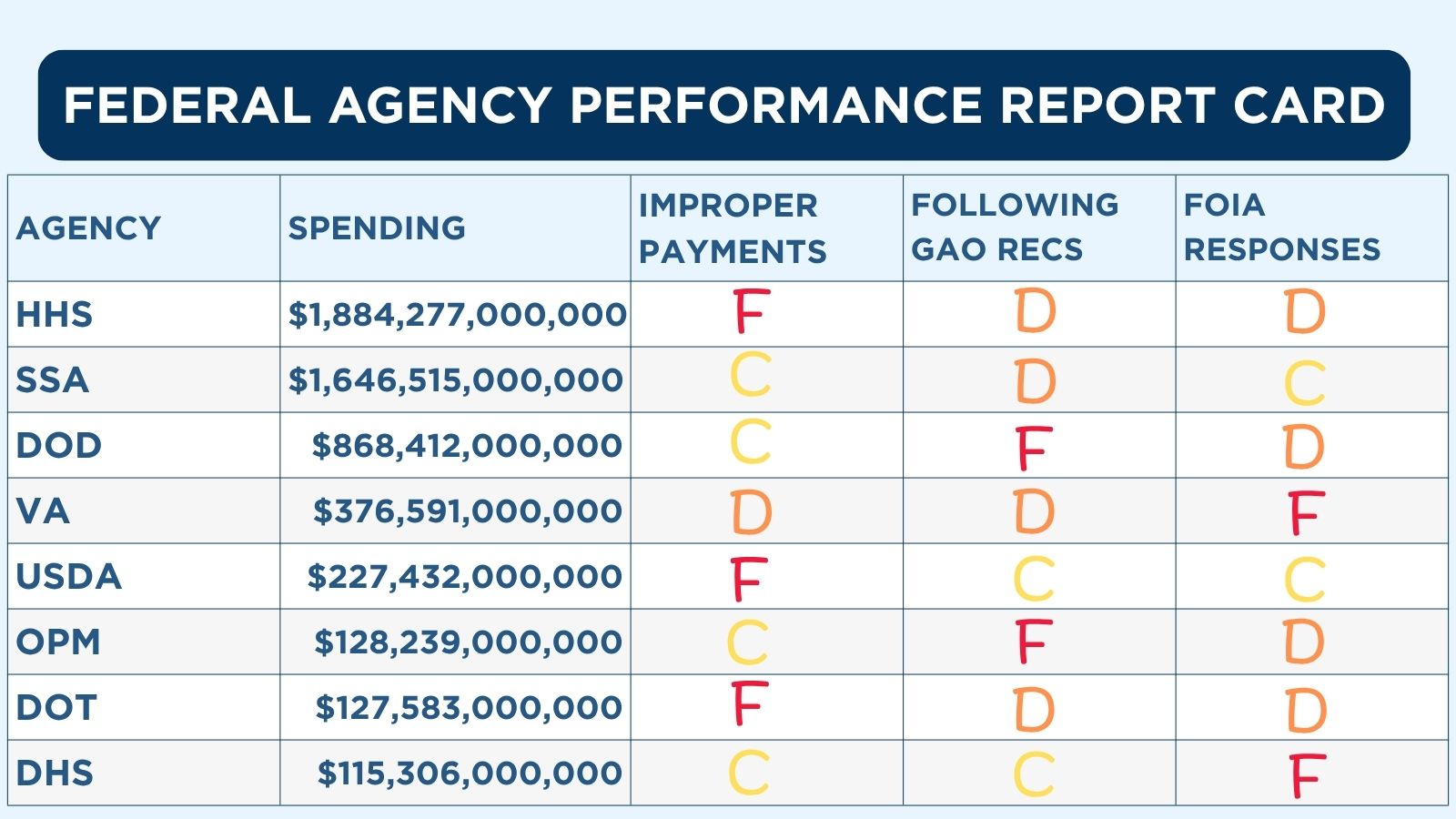
This Tax Day, hundreds of millions of Americans will pay trillions of dollars in federal taxes to the Internal Revenue Service. The vast majority do not know where their hard-earned dollars go. To provide some insight into the black box that is the federal government, the Taxpayers Protection Alliance (TPA) has created the following report card to not only track the expenditures of top-spending agencies but also grade them on key areas of performance. The agencies reviewed—in descending order of how much they spent in 2025—are: the Department of Health and Human Services (HHS), the Social Security Administration (SSA), the Department of Defense (DoD), the Department of Veterans Affairs (VA), the Department of Agriculture (USDA), Office of Personnel Management (OPM), the Department of Transportation (DOT), and the Department of Homeland Security (DHS).
Here are the key areas that TPA graded these agencies on:
Improper Payments: PaymentAccuracy.gov, which is the federal government’s central platform for tracking and reporting on improper payments, provides a comprehensive overview of which agencies did the best—and worst—at targeting and monitoring their spending in 2025. While agencies such as the HHS and USDA misdirected more than five percent of funds, the total for other agencies (e.g., DHS) was less than one percent.
Addressing GAO Recommendations: The Government Accountability Office (GAO) regularly issues recommendations to agencies on ways they can save money and avoid duplication. However, whether the agencies listen is another matter entirely. For this metric, TPA compared the “number of open duplication and cost savings recommendations” for 2024 and 2025. While some agencies such as the DoD reported large increases in year-over-year open recommendations, others such as the USDA reported large decreases (but still multiple significant open items). This variation is reflected in TPA’s grading for this category.
Granting FOIA Requests: Agencies are statutorily bound to answer Freedom of Information Act (FOIA) requests, but they often exploit one or more of the multiple (broad) exceptions under the law. It is critical that agencies answer FOIA requests within reason because these requests often shed considerable light on how various programs are working and what they are costing taxpayers. Of the agencies surveyed, only one (USDA) fully granted more than half of FOIA requests. Meanwhile, the VA and DHS granted less than five percent of requests.