
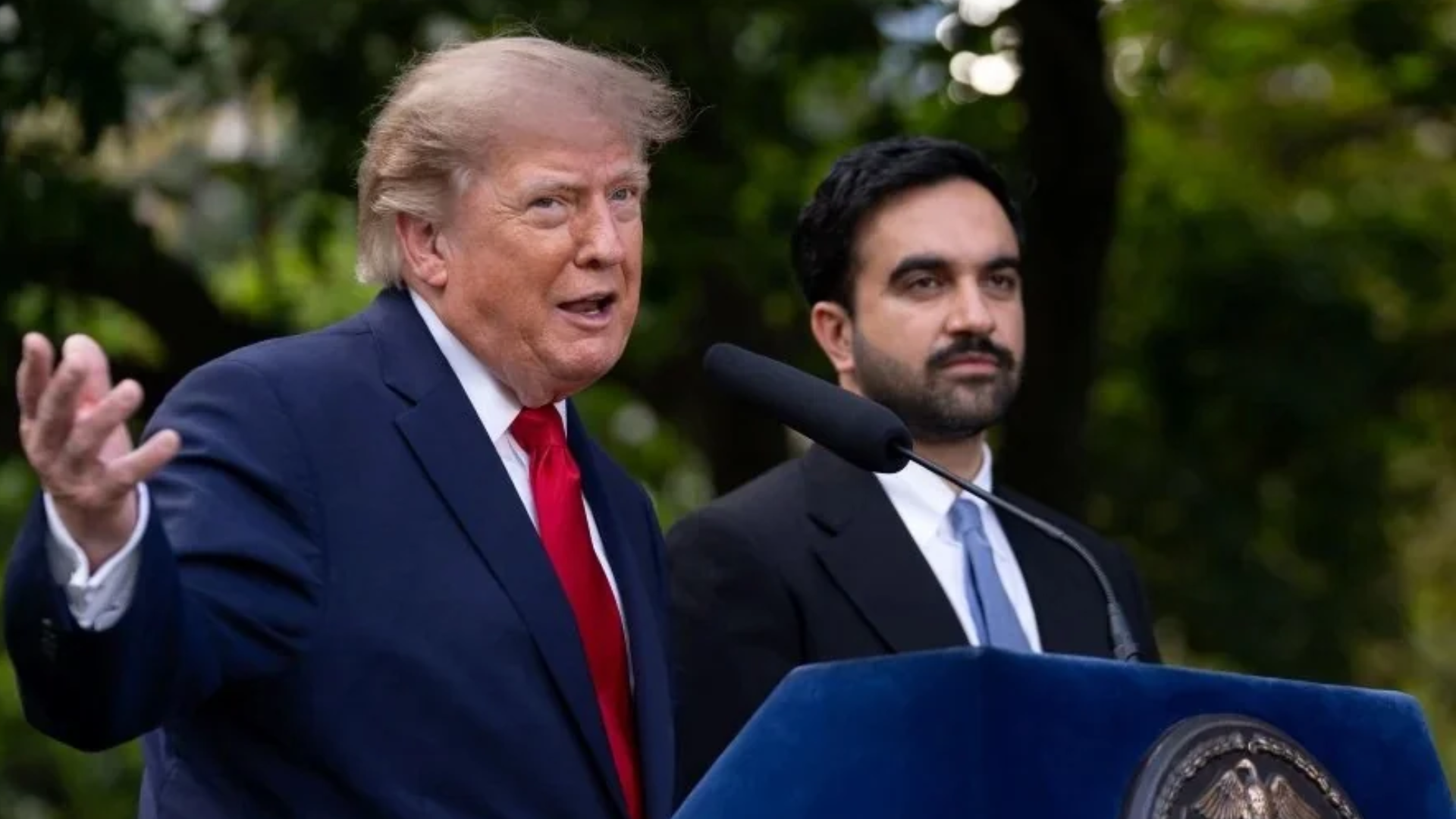
Zohran Mamdani and Trump are Reading From the Same State-Capitalist Playbook
David B McGarry
November 3, 2026
This op-ed was originally published in Inside Sources.
To object to a new usage of state power proposed by a Republican politician on the grounds that, in the future, a Democrat might use the same power is considered jejune by much of the modern right.
It is all so very GOP circa 2012, they say — then the phrase “beautiful losers” might be deployed as if it were a rhetorical finishing move of irresistible force. Q.E.D.
However, once a new power of government is deployed, or once a procedural barrier is leveled, the other party will likely deploy that power again in the future, and opposition forces will march across the newly cleared procedural flatland easily. Saying so may be trite, and may not authoritatively decide any given debate, but the observation is nonetheless true.
For all the Republican Party’s vituperations of socialism, the median GOP voter might not have anticipated when entering his local polling station in 2024 that the second Trump administration would develop a taste for assuming equity stakes in private businesses. The count, current as of this writing, reaches 35 companies, according to the Cato Institute.
Zohran Mamdani, the mayor of New York City, describes his relationship with Donald Trump as “honest, direct and productive.” On Wednesday, aping the president, Mamdani announced a public–private partnership with Quantum Technology Lab at N.Y.U. by whose terms the city will gain three seats on the lab’s board and “15 percent of the NYU Central Administration’s proceeds resulting from the intellectual property — including equity, royalties, milestone payments and licenses of the patent.”
Deputy Mayor for Economic Justice Julie Su protested that the city drew inspiration not from the Trump administration but rather from models of democratic socialist governance. This offers scant comfort with respect to either the bipartisan proliferation of state capitalism or to the current White House’s economic bedfellows.
Even before Mamdani’s foray into state capitalism, progressives had begun to discuss repurposing Trump’s equity-stakes stratagem for their own purposes, Politico reports.
What Trump began, the next Democratic president will likely finish. Stipulated, arguendo: Democratic thinking possesses no limiting principle that precludes state-owned firms or, even, industries. Rep. Alexandria Ocasio-Cortez, D-N.Y., for one, has long favored the idea. California Gov. Gavin Newsom, who decried Trump’s Intel deal as reminiscent of the Red Chinese, overcame his negative partisanship and proposed public equity in artificial intelligence firms.
This does not, however, exculpate Trump. Until recently, a president unilaterally, (and perhaps illegally) acquiring equity stakes in private companies would have been unthinkable; a decade ago, anyone suggesting Trump would attempt such a thing would have been diagnosed with Trump Derangement Syndrome. Trump has made it thinkable, and, worse, made it the policy of the one political party which, ostensibly, at least, opposes economic statism.
In any free republic, in which public opinion sooner or later predominates, the reflexive aversions of the electorate do much to maintain good governance: many policies are not pursued because doing so would incite an outcry, even if much of the public could not explain, philosophically, the full reasons for it.
Anything smacking of socialism could, until relatively recently, be counted in this category. These aversions can be ground down, worn away. This reflexive faculty — common sense — is often underrated by political scientists, even though common sense among the citizenry serves as one of the trustiest barriers against tyranny.
Democrats have done much since 2009 to acclimate the nation to socialism, but Trump’s affinity for public ownership of once-private enterprise is something altogether different in kind from his Democratic predecessors’ errors. This observation stands; notwithstanding his trade policy, the president tends on the whole to favor freer markets than they.
The means of production are not being seized. Accounting for the lure of subsidization and the dangers of regulatory retaliation that attend denials of White House requests for, well, most anything, a CEO’s decision to give equity to the Trump administration cannot be counted as purely voluntary, either.
As James Madison knew, “An advisory Govt is a contradiction in terms.” Lip-Bu Tan, CEO of Intel, discovered this bit of Madisonian wisdom in the summer of 2025, when he artfully parried Trump’s attempt to secure his firing by making the federal government the largest shareholder in America’s designated national champion in the semiconductor industry.
Outright seizure has occurred on one occasion, though: in Venezuela. Last month, the White House touted a deal by which Venezuelan oil will be extracted by a firm owned in large part by the federal government. “The U.S. plans to take a 35 percent passive stake in Betancourt’s North American Blue Energy Partners and would secure preferential rights to purchase 20 percent of its production at cost,” The Wall Street Journal explained.
To revive the country that languished for decades under the socialism of Hugo Chávez and Nicolás Maduro — an aim of Secretary of State Marco Rubio — a state-owned enterprise is, we are to believe, necessary. The administration’s attempt to persuade the American people that public enterprises, not private ones, are best suited to furthering the interests of the American people will, if unchecked, further damage American common sense, which has traditionally resisted that presumption.
The law is a teacher, and Trump has undertaken to instruct the nation that socialism is not anathema to America’s founding principles, her liberty, her history, or her way of life.
Mamdani’s adventurism, by virtue of his office, is confined to New York City; but the next Democrat to stride into the White House will not be confined to a single locality. When a President Newsom or AOC inevitably picks up the pen or phone on the Resolute Desk to entangle the U.S. government with a green energy company, the American people — or some of them, at least — will almost certainly object.
The objections are likely to be far tamer, far more tepid, than they otherwise would have been had Trump withstood the socialist temptation.
Indeed, Mamdani’s announcement emerged to little media coverage and little criticism. To anyone who disfavors socialism, this near silence ought to rankle — it ought also to herald the inoculation of public opinion, on a bipartisan basis, to the state ownership and direction of the means of production.