Low-Income & Smoking: Virginia
Taxpayers Protection Alliance
May 8, 2021
An increase on tobacco and vapor products would unfairly burden lower income Virginians. Excise taxes are inherently regressive and tend to burden lower income persons. For example, a Cato Journal article found from 2010 to 2011, “smokers earning less than $30,000 per year spent 14.2 percent of their household income on cigarettes, compared to 4.3 percent for smokers earning between $30,000 and $59,999 and 2 percent for smokers earning more than $60,000.”[i]
According to the Centers for Disease Control and Prevention’s (CDC) Behavioral Risk Factor Surveillance Survey, in 2019, 14 percent of adults in the Old Dominion were current smokers, amounting to 934,454 smokers.[ii] Further, 9.5 percent of Virginia adults (634,094) were daily smokers in 2019.
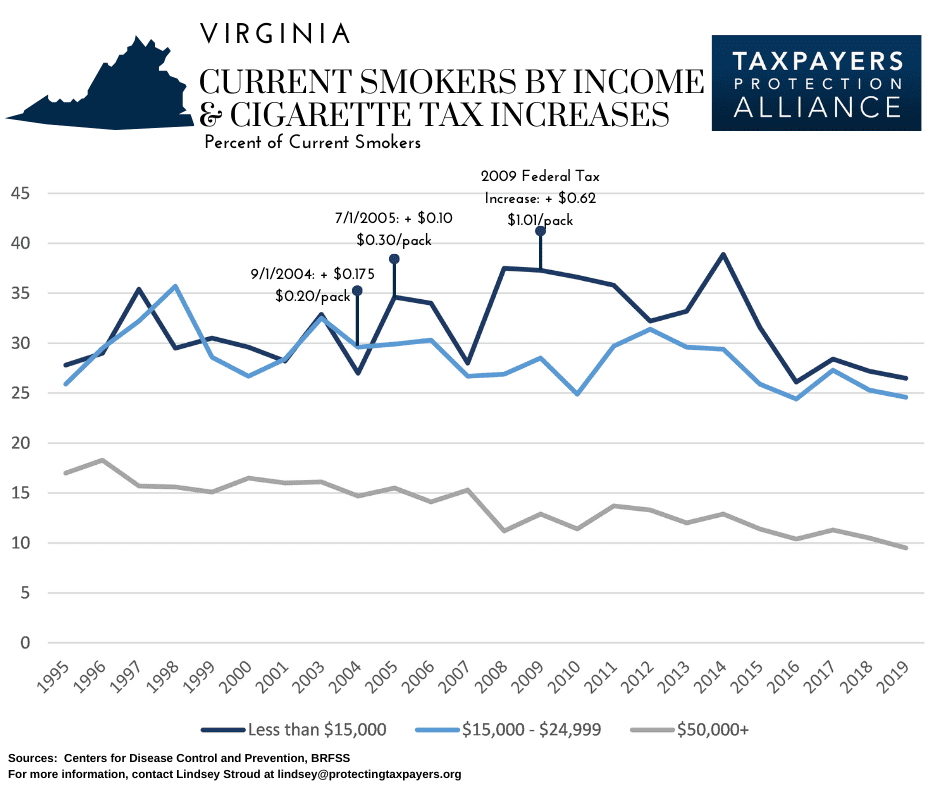
In Virginia, in 2019, among current adult smokers, 26.5 percent reported annual incomes of less than $15,000 and 24.6 percent of current smokers reported earning between $15,000 and $24,999 per year. Indeed, over half (51.1 percent) of all current adult smokers earned less than $24,999 per year in 2019.
State excise tax increases did not lead to significant declines in smoking rates among lower income persons. For example, in 2005, Virginia increased the cigarette tax by $0.10, to $0.30-per-pack. By 2007, two years after the tax increase, smoking rates among persons earning less than $24,999 per year decreased by 15.2 percent from 64.5 percent of adult smokers to 54.7 percent of adult smokers. Among smokers earning $50,000 or more, smoking rates decreased by 1.3 percent from 15.5 percent in 2005 to 15.3 percent in 2007. Smoking rates have decreased among high-income smokers and in 2019, only 9.5 percent of all current smokers reported earning $50,000 or more.
Moreover, the 2009 federal excise tax increase did not lead to a significant decline in smoking rates among lower income persons in Virginia. In 2009, 65.8 percent of smokers reported earning less than $24,999 per year. This decreased by only 0.5 percent to 65.5 percent in 2011. Current smokers earning $50,000 a year or more increased by 6.2 percent from 12.9 percent in 2009 to 13.7 percent in 2011.
There is scant information on adult e-cigarette use as the CDC only reports information on such use for only 2016 and 2017. Nonetheless, lower income persons tend to use e-cigarettes at greater rates than high income Virginians. For example, in 2017, 11.6 percent of all adults reported using e-cigarettes had incomes of $24,999 or less. Conversely, only 3.8 percent of all Virginia adults that had reported using e-cigarettes had incomes of $50,000 or greater.
Any increase on cigarette and/or vapor taxes will disproportionately impact low-income Virginians, and may have little-to-no effect on reducing smoking rates.
[i] Kevin Callison and Robert Kaestner, “Cigarette Taxes and Smoking,” Regulation, Cato Institute, Winter 2014-15, https://object.cato.org/sites/cato.org/files/serials/files/regulation/2014/12/regulation-v37n4-7.pdf.
[ii] Centers for Disease Control and Prevention, “BRFSS Prevalence & Trends Data,” 2019, https://www.cdc.gov/brfss/brfssprevalence/.